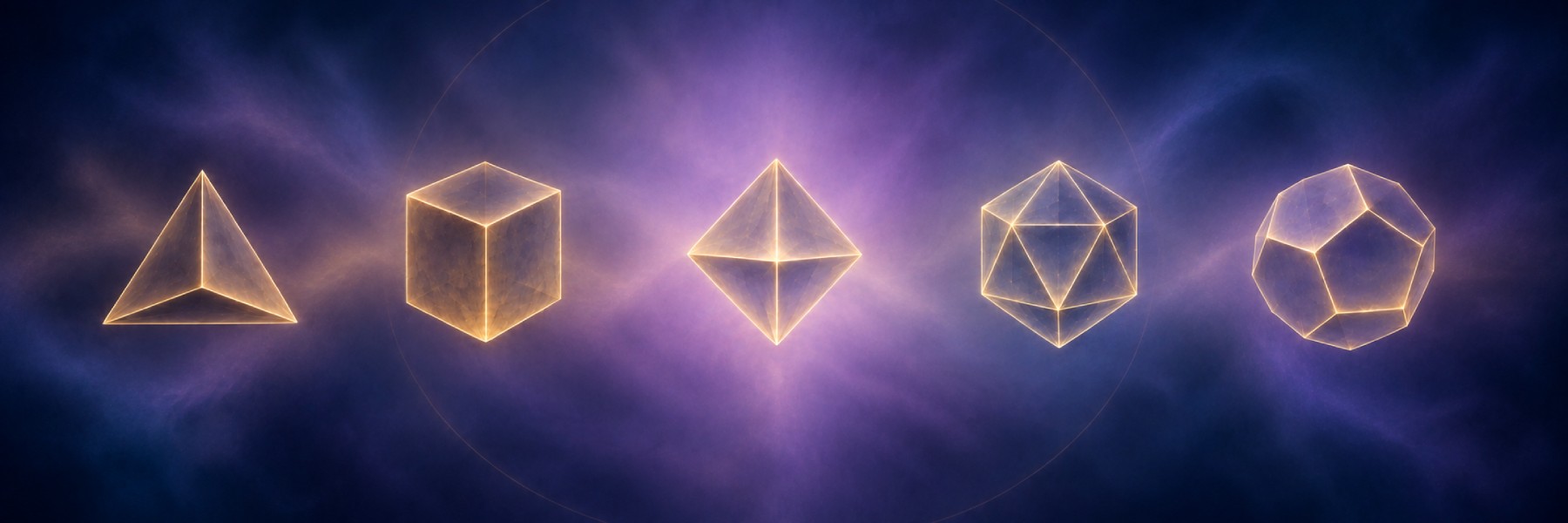
The Fundamentals
of Sacred Geometry
Patterns, Form and Meaning

Behind you: the forgetting.
The belief in separation.
The illusion that you are small, alone, finite.
Before you: the remembering.
The recognition of unity.
The truth that you are infinite, connected, eternal.
This threshold is not new.
You have crossed it before — in dreams, in meditation,
in moments of profound beauty when ordinary perception fell away and,
for an instant, you recognised something that had always been present.
You have always known this place.
You are returning home.
As We Begin
The journey here begins with simplicity.
The illustrations on this page have been deliberately simplified to their essential forms so that the geometry may be seen without distraction. Before Sacred Geometry becomes intricate, it is beautifully simple. Before it reveals complexity, it reveals relationship. And before it becomes architecture, it becomes presence.
The accompanying text, also, has been streamlined for clarity.
Think of these images as meeting old friends for the first time.
Become familiar with their shapes. Sit quietly with them. Allow them to speak in their own timeless language. The more intimately you know these fundamental forms, the more naturally the deeper geometries that follow will reveal themselves.
In meditation, I have often perceived faint geometric forms arising within the darkness behind closed eyes — subtle structures of line and pattern, present for a time and then changing or dissolving. These experiences became part of the inspiration for The Geometry of Souls.
What Makes Geometry Sacred?
Sacred Geometry is not a separate branch of mathematics with an official catalogue of approved forms. A circle remains a circle; a triangle remains a triangle. What makes geometry sacred is the meaning human beings have perceived, expressed and contemplated through it.
Across cultures and centuries, geometric forms, patterns, proportions and spatial relationships have been used to explore ideas of creation, harmony, wholeness, transformation, cosmic order and relationship between the human, natural and divine.
There is therefore no single, universally agreed collection called Sacred Geometry. Some forms recur across many cultures and periods; others belong more particularly to certain philosophical, spiritual, architectural or artistic traditions. Meanings can also differ profoundly between cultures, even where similar forms appear.
The forms gathered here are consequently a foundation, not an exhaustive catalogue. There are many more patterns, constructions, variations and relationships than we could reasonably include on these pages, and some will appear later as The Geometry of Souls continues to unfold.
We have also allowed a few forms into this collection that may not ordinarily be classified as Sacred Geometry at all. They are here because geometry can teach through relationship as well as classification. A form may illuminate something about balance, interconnection, transformation, perception or the human experience so beautifully that it earns a place in this particular journey.
The intention, then, is not to establish a rigid canon.
It is to learn the language well enough that we begin to recognise its patterns — and perhaps discover what they awaken within us.
The Language Preceding Words
Long before formal written language, human beings were making patterns.
Circles, spirals, intersecting lines, grids and repeated forms appear across the material record of human cultures. Over time, geometry became not only decoration, but a means through which people expressed information, relationship, memory, order and, in many traditions, the sacred.
What follows in this chapter is therefore offered not simply as a lesson to be studied, but as a language to be encountered.
Each form — the Void from which all things emerge, the single Point of origin, the Circle of wholeness, the Vesica Piscis of meeting, the Flower of Life, the Platonic Solids, the Spiral, the Cross, the Torus — is presented through more than one lens.
There is the geometry itself: what can be drawn, measured and demonstrated.
And there are the meanings human beings have associated with these forms across philosophy, spirituality, art, architecture and contemplation. You don't need to accept any particular interpretation in order to be moved by them.
Some patterns may feel immediately familiar. Others may awaken curiosity, recognition or simply an appreciation of their mathematical beauty. Geometric forms also arise naturally in many places — in human mark-making, in architecture and ornament, in natural structures, and sometimes within our own inner experience.
As you journey through these forms, we invite you to try something different from ordinary looking.
Let your gaze soften. Let your breath slow.
Rather than examining every form only with the analytical mind, allow yourself occasionally to rest within it — to imagine sitting inside the Circle, floating within the Sphere, tracing the Spiral with your own unhurried breath.
Perhaps geometry can be approached not only as something we calculate, but as something we experience.
Within The Geometry of Souls, we explore the possibility that these ancient relationships of point, line, proportion, symmetry, movement and form can also become metaphors through which we contemplate consciousness, creation and Divine Love.
Become familiar with these fundamental forms, and the deeper chapters ahead — the Merkaba, the Cross, Infinity, the geometries beyond three dimensions, cultural connections, Sacred Places and the many patterns still to come — will begin from common ground.
This gallery follows a natural arc: stillness, meeting, unfolding, breathing, flow, growth, heart, axis, matter, synthesis, activation — the same journey your own soul has always known, traced now in light and line.
The Void
The Void Becomes Form
In the 'beginning', there was The Void.
Infinite potential, not emptiness.
Pure consciousness, undifferentiated and eternal,
resting within itself before the first act of creation.
This is the moment before form. The moment before time.
The silent stillness before the first vibration.
The Void is not nothing.
It is everything before manifestation.
Infinite possibility.
The eternal NOW.
The first breath of All That Is.
And then — the impulse arose.
The One wished to know itself.
And in that wishing: a Point.
The first distinction within the infinite. The first I AM.
The moment consciousness chooses to know itself through form.
From the Point, dimension can begin. The Point becomes the origin from which line, circle, sphere and all subsequent geometry may unfold. Across cultures and philosophical traditions, human beings have returned again and again to the mystery of beginnings: darkness before light, silence before sound, formlessness before form, the unmanifest before the manifest.
The Geometry of Souls approaches The Void in this same spirit — not as an absence, but as potential.
The Point emerging from The Void becomes our first geometric expression of that mystery: possibility becoming presence. The first movement from potential into experience. The first doorway. The source from which all subsequent patterns emerge.
LOVE - The All That Is becoming visible.
*LIFE. Love In Full Expression.
How to Work With The Void
Sit for a moment in genuine stillness before any image or thought arises.
Close your eyes, or soften your gaze.
Do not seek anything.
Simply rest in not-knowing.
Not-forming. Not-becoming.
Allow yourself, briefly, to inhabit possibility without requiring it to become anything at all.
In this practice, The Void becomes something to experience: the quiet space before thought, decision, movement or creation, not something to understand intellectually.
Remain there for a few minutes.
Then notice what arises.
*LIFE - LOVE In Full Expression* the acronym gifted to our world by Suzanne Giesemann, and used with kind permission.
The Point
The Point
The First Arising
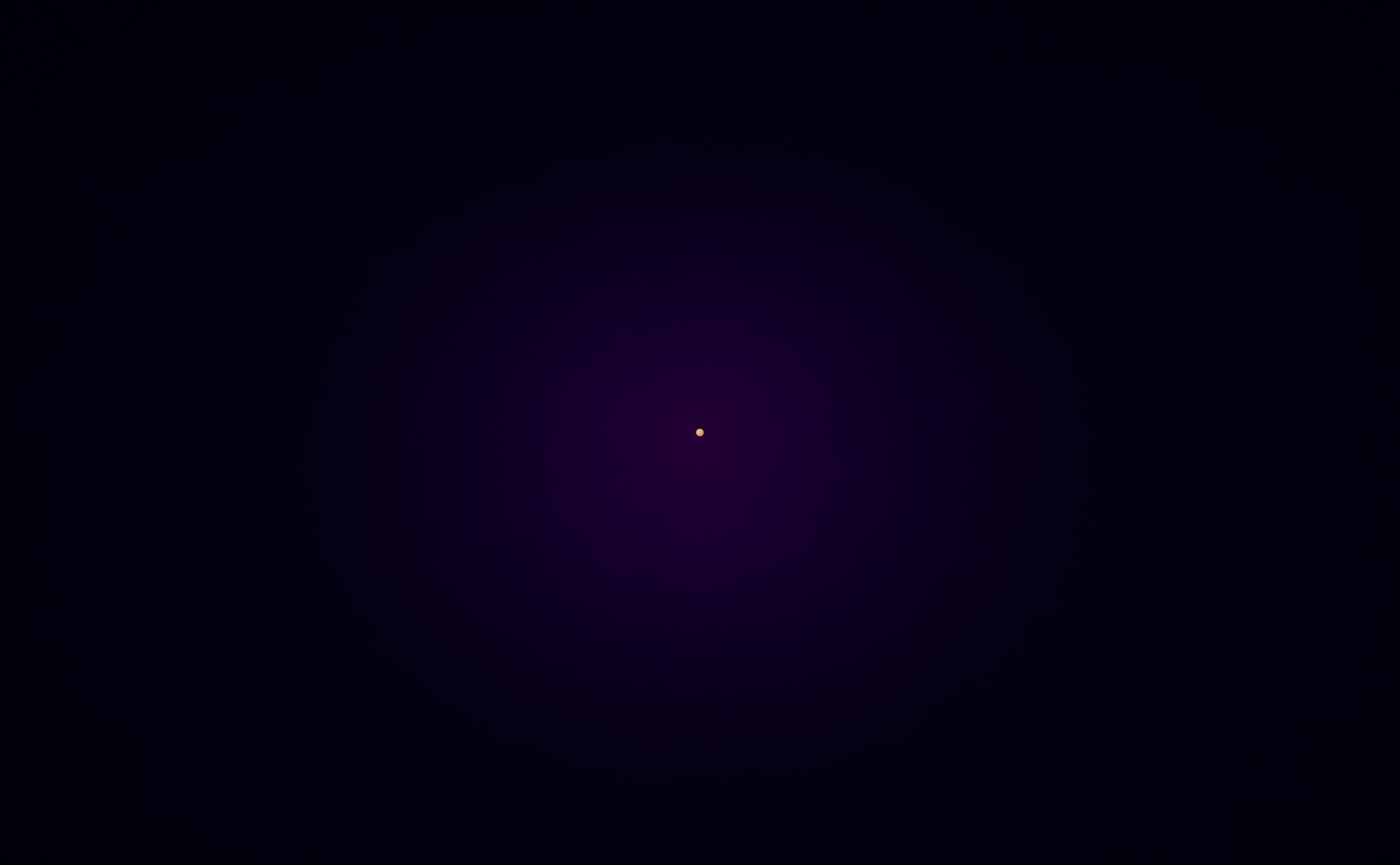
From The Void — infinite, undifferentiated potential — comes a single point of light. This is the first yes of creation: the moment pure possibility becomes presence. A location appears where no location existed before.
This is the geometry of beginning: A mathematical point has no dimension. No length. No width. No depth. It simply establishes position.
Before the Point, within the symbolic language of The Geometry of Souls, there was no here. With the Point, here becomes possible.
Every line begins with points. Every geometric construction requires location. From the first point, relationship can begin: another point may appear, distance may arise between them, and geometry can begin to unfold. The Point is therefore both almost nothing and enormously consequential. It occupies no measurable space, yet establishes the possibility of place.
Where We Encounter Its Echo
The mathematical point is an abstraction; perfect dimensionless points do not appear as physical objects in nature. Yet the principle of origin, centre, and concentrated beginning appears everywhere.
We may contemplate it in the fertilised egg from which a new organism develops; in the dark centre of the pupil through which light enters the eye; in a seed before germination; or in a single moment of attention gathered from the enormous field of awareness.
Sacred traditions have also used the point as a powerful contemplative symbol. In several Indian philosophical and sacred-art traditions, the bindu — Sanskrit for “point” or “dot” — may represent a centre, origin or concentrated source from which manifestation unfolds. It appears within yantras and other sacred geometric forms as a point of extraordinary symbolic potency.
Here mathematics and contemplation meet without needing to become the same thing.
Mathematically, the Point establishes position. Symbolically, it can become origin. Spiritually, it may be contemplated as presence.
Within The Geometry of Souls
The point becomes the moment when the infinite first declares: I AM. Not yet what I am. Not yet where I am going. Simply: I AM (here). And, within The Geometry of Souls, the Point is not the opposite of infinity. It is infinity choosing a place to begin. This is the geometry of origin.
This is the first spark of I AM.
How to Work With The Point
Bring your awareness gently to a single point.
It might be the tip of a candle flame, a small mark upon paper,
or simply the felt sense of your own centre.
Allow your attention to gather there.
Notice what happens when awareness, capable of travelling almost anywhere,
rests for a moment in one place.
You need not make anything happen.
Simply experience the difference between the vast field of awareness
and the single place upon which awareness has chosen to rest.
Then ask quietly:
Where is my centre now?
Remain with whatever arises.
The Circle
The Circle
Wholeness Remembered
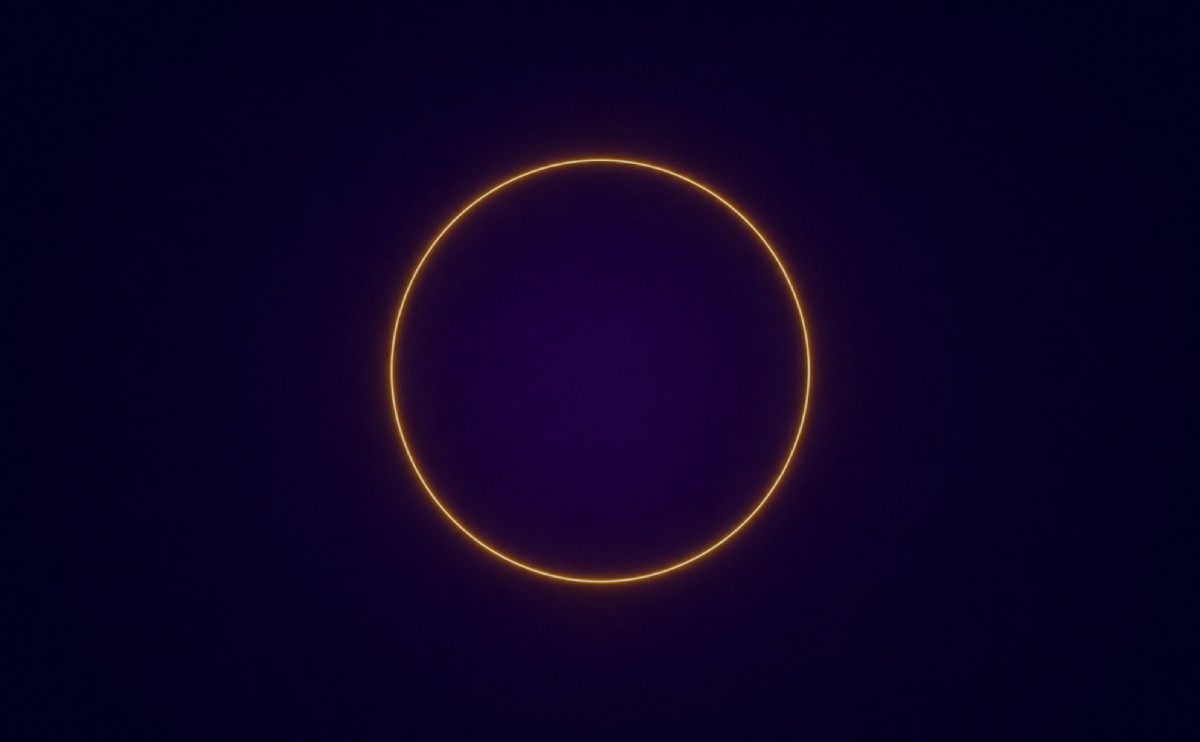
From the Point, imagine awareness expanding equally in every direction upon a plane. A boundary emerges. The Circle is born.
Every point upon its circumference lies at exactly the same distance from its centre. Nothing on the circumference is geometrically privileged above anything else. Centre and circumference enter into relationship.
This is the geometry of wholeness: A circle has no beginning and no end. Trace its circumference and you return to where you began. Every point upon that circumference is equidistant from the centre. The boundary is continuous and unbroken. The centre remains still while the circumference embraces the space around it.
The Circle becomes our first expression of wholeness — multiplicity held in perfect relationship to a common centre.
The Point established presence. The Circle creates a field around it. Something has expanded, yet the centre has not been lost.
Where We Encounter Its Echo
Perfect mathematical circles are abstractions, yet circular and approximately circular forms appear throughout nature and human culture. We see their echo in the apparent discs of the Sun and Moon; in the pupil and iris of the eye; in ripples spreading across still water; in cross-sections of stems and fruits; and in countless natural processes shaped by rotation, radial growth and symmetry.
Human beings, too, have returned repeatedly to circular forms.
Stone circles such as Stonehenge and Avebury demonstrate the importance of circular and roughly circular monumental arrangements in prehistoric Britain. Mandalas within Buddhist and Hindu traditions employ circles and concentric structures within complex symbolic systems of contemplation, cosmology and sacred order.
The circle also appears wherever people gather around a shared centre — around fires, tables, ceremonial spaces and places of conversation. The geometry itself makes no person more important than another. If each person occupies the circumference of a circle, each stands at the same geometric distance from its centre. That does not mean every human gathering in a circle has been equal or without hierarchy. Rather, the form offers us a powerful symbol of equality: many positions, held in equal relationship to a common centre.
Within The Geometry of Souls
The centre of the circle may be understood as consciousness. As source. As Love. And the circumference as the countless expressions arising around it. Many points. One centre. One unbroken whole.
The Circle does not need to prove anything. It simply is — complete, exactly as it stands. This is the geometry of wholeness.
This is Love, our Source — as unbroken unity, remembering itself.
How to Work With The Circle
Bring your attention to a simple circle.
Allow your gaze to travel slowly around its circumference.
Notice that wherever you begin, there is no privileged starting place.
Continue long enough and you return naturally to where you began.
Then become aware of the centre.
Imagine yourself resting there.
The circumference may expand outward in every direction, yet the centre remains still.
For a few moments, simply experience both:
the stillness of the centre and the wholeness that surrounds it.
Notice what arises.
The Vesica Piscis
The Vesica Piscis
The Sacred Intersection
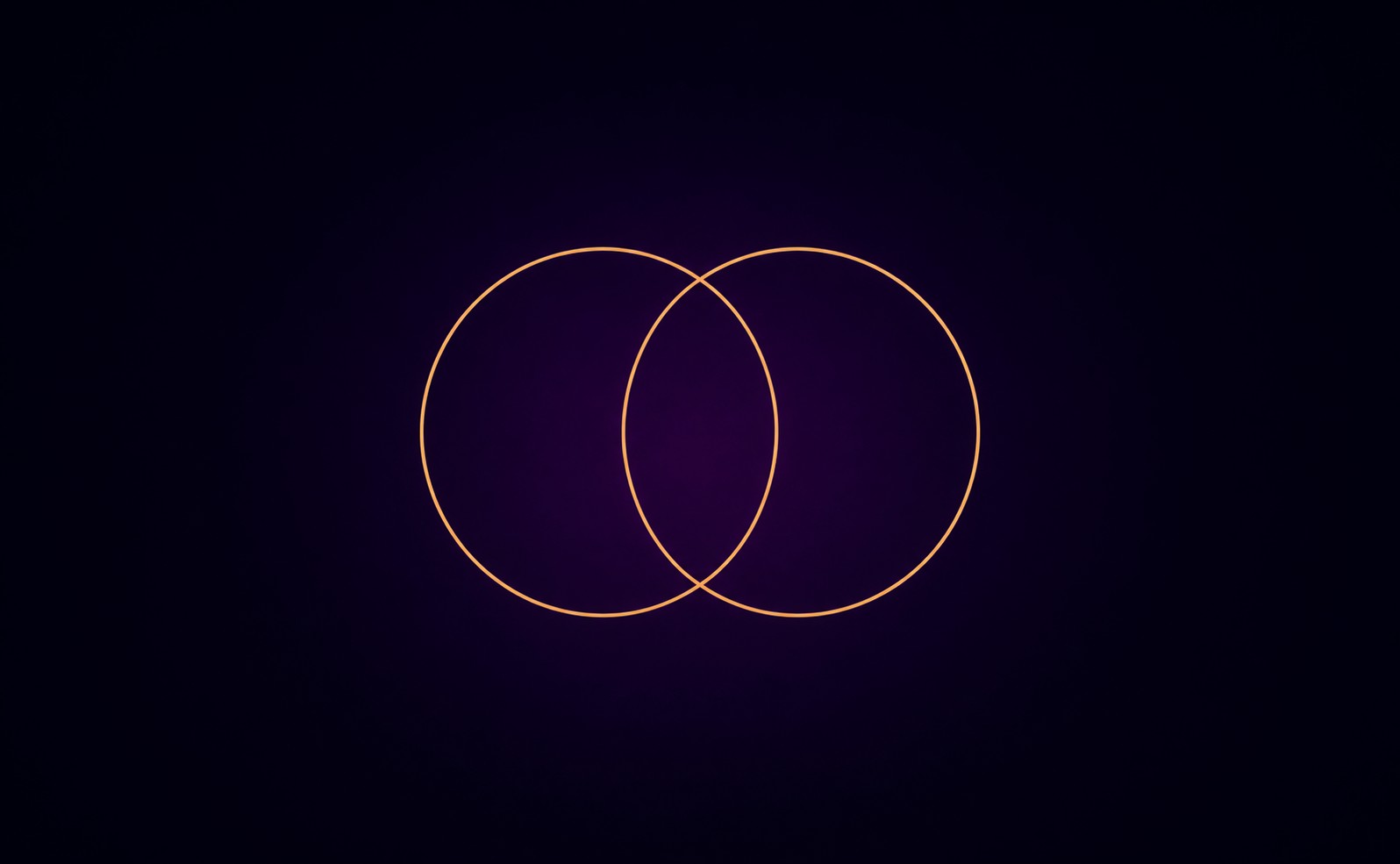
One Circle has established wholeness. Now imagine another circle of exactly the same size appearing beside it. The two overlap. Neither disappears. Neither becomes the other. And yet, through their meeting, something exists that neither circle could create alone.
Between them appears the Vesica Piscis — the almond-shaped region formed by the intersection of two equal circles. This is the geometry of relationship: Two circles. Two centres. Two distinct fields. Each remains whole in itself. Yet where they intersect, a third space appears.
The Geometry Beneath the Symbol
In one classical construction of the Vesica Piscis, two equal circles are positioned so that the centre of each lies upon the circumference of the other. From an extraordinarily simple act — one circle meeting another — a rich geometry emerges.
The two points where their circumferences intersect establish a new axis. Lines connecting those intersections with the two centres generate equilateral triangles, and further proportions and constructions can unfold from the same relationship. Simplicity has begun creating complexity.
Within the unfolding language of this chapter, this matters.
The Point gave us presence.
The Circle gave us wholeness.
The Vesica Piscis gives us relationship. And relationship creates possibility.
Where We Encounter Its Echo
The almond-shaped form of the Vesica Piscis has appeared in sacred art and architecture in many different contexts. In Christian art, the related almond-shaped mandorla has often surrounded figures such as Christ or the Virgin Mary, marking a radiant or sacred space around the figure.
Intersecting arcs and related geometric constructions also belong to the vocabulary from which pointed forms can be created in Gothic architecture, although not every pointed Gothic arch is itself a Vesica Piscis.
The form also invites associations with the eye, the womb, the seed, the opening and the portal. These are symbolic correspondences rather than anatomical identities, but their visual resonance has helped the form acquire a rich contemplative language.
Within The Geometry of Souls
This is the geometry of co-creation and becomes our first geometry of relationship. The Circle showed us wholeness. The Vesica Piscis asks what happens when one wholeness encounters another. Neither must surrender its centre. Neither must cease to be itself. Yet their meeting creates something genuinely new. The space between becomes generative, and we can also contemplate the Vesica Piscis as a threshold:
self and other,
inner and outer,
above and below,
known and unknown.
Two realities meet. Neither need cancel the other. And within their intersection, another possibility appears. Perhaps this is one of the deepest geometries of Love. Not absorption, possession, or the disappearance of one into another, but relationship without the loss of self. Two centres remain. And something new is born between them.
This is Source. This is Love discovering what becomes possible when one meets another.
How to Work With the Vesica Piscis
Visualise two equal circles slowly moving towards one another until they overlap.
Allow one circle to represent one reality, experience or perspective.
Allow the other to represent another.
Perhaps they appear contradictory.
Perhaps you have believed that only one can be true.
Now bring your awareness to the space where they intersect.
Do not force them into agreement.
Do not require one to defeat the other.
Simply remain within the meeting place.
Ask quietly:
What becomes visible here that I could not see from either circle alone?
This is a practice of moving gently from either/or towards both/and — not by denying difference,
but by allowing relationship itself to reveal another possibility.
Notice what arises.
The Tripod of Life
The Tripod of Life
The Sacred Third
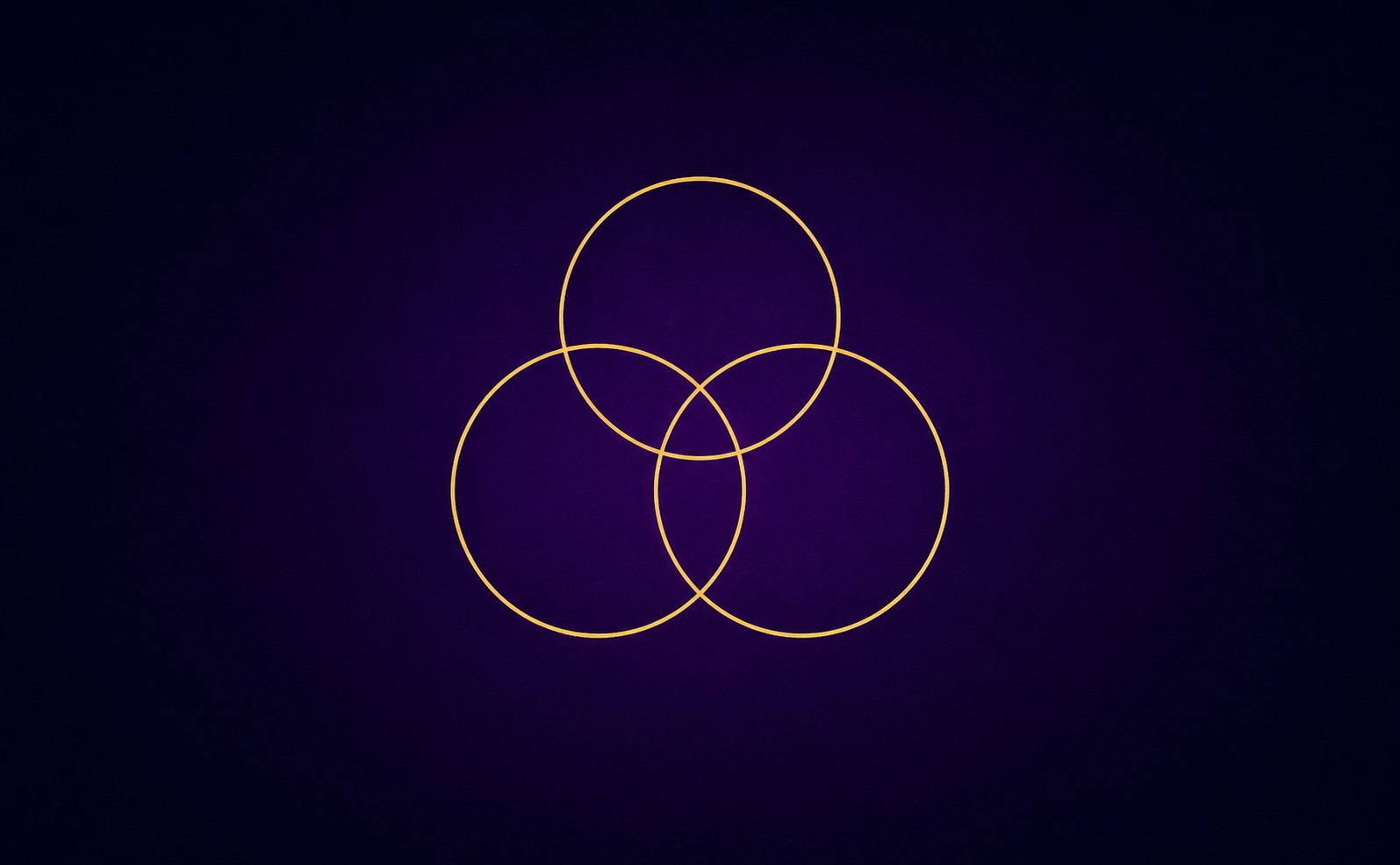
The Vesica Piscis introduced relationship. Now add a third equal circle. Something remarkable begins to emerge: a geometry of three.
Three circles enter into relationship, each participating in a shared field. Where the Vesica Piscis gave us the meeting of two, the Tripod of Life introduces a third presence — and with it, another order of possibility.
This is the geometry of the Sacred Third: Three circles. Three centres. Three distinct presences.
Each remains whole in itself, yet each participates in a larger pattern. Together they create relationships and spaces that none can create alone. The arrival of the third transforms the geometry. Two established relationship. Three begin to establish a field.
The Geometry of Three
The Tripod of Life invites us to contemplate something the Vesica Piscis alone cannot: that some forms of wholeness arise not through polarity, but through triadic relationship. Two points establish a line. Three non-collinear points establish a plane. Three straight sides create the triangle — the simplest polygon and the first enclosed plane figure that can be constructed from straight lines. With three, geometry acquires another order of possibility.
Threefold structures also appear repeatedly within human thought and culture:
body — mind — spirit;
past — present — future;
birth — life — death;
maiden — mother — crone;
beginning — middle — end;
Mother - Father - Holy Spirit.
These triads arise from different traditions and contexts and need not share a single historical origin. Yet their recurrence invites contemplation. Why does three so often become a language through which human beings organise relationship, transformation and wholeness?
The Borromean Rings
The Borromean Rings
Another Geometry of Three
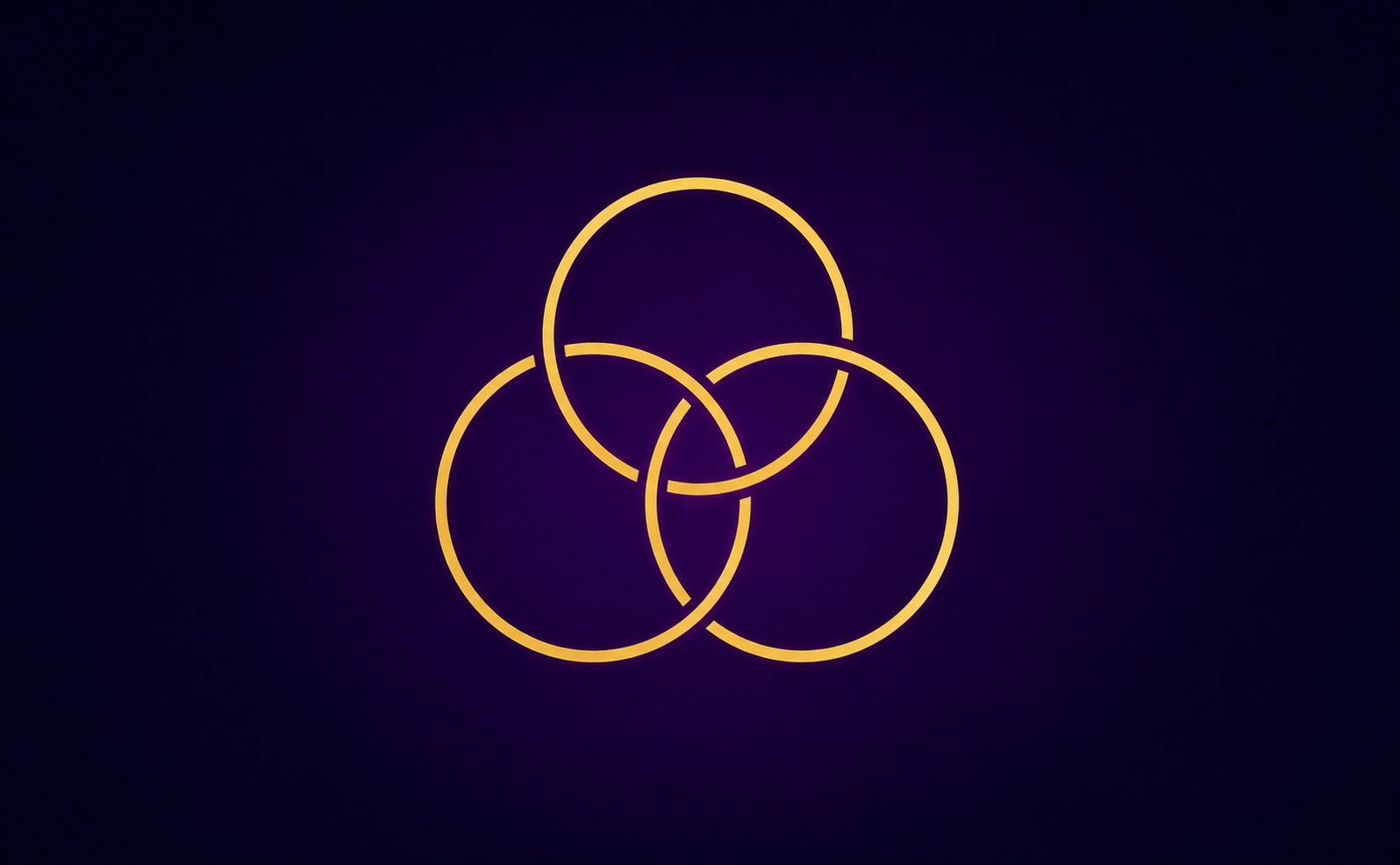
There is another, related geometry that carries the principle of threefold relationship even further: the Borromean Rings.
Unlike three simply overlapping circles in a plane, the Borromean Rings are three interwoven loops. Their remarkable property is that although all three together are linked, no two are linked independently. Remove any one ring — and the remaining two are released. Mathematically, this is an example of a Brunnian link: a linked structure that becomes completely unlinked when any one component is removed.
Here, the symbolism of interdependence becomes profound. The whole exists through the relationship of all three. No pair alone can reproduce it. Remove one, and the structure of relationship dissolves. It is unity that cannot be reduced to a simpler pairing.
Within The Geometry of Souls
Here, the Sacred Third becomes more than another object placed between two others. It may be understood as something emergent: The relationship itself. The field created through meeting. The unseen possibility born when one encounters another. The Vesica Piscis gave us two centres meeting without either losing itself. Now the Sacred Third asks: What has their meeting created? Maybe the third is not always another being. Conceivably, it's the space between. The witness. The relationship. The field. And perhaps, sometimes, Love itself. Something can arise through relationship that belongs wholly to neither participant, yet could not exist without them both.
This is not something geometry proves about consciousness or Love. Rather, geometry gives us a form through which the mystery of emergence can be contemplated.
This is the geometry of sacred relationship. This is Source — this is Love — as relationship giving rise to something new.
How to Work With the Sacred Third
Visualise two circles meeting.
Allow each to represent something distinct:
two people, two perspectives, two possibilities, or two aspects of yourself.
Now imagine a third circle entering the relationship.
Do not immediately decide what it represents.
Instead, bring your attention to the larger field created by all three.
Ask quietly:
What becomes possible here that could not arise from either relationship alone?
Perhaps the third is an unexpected possibility.
It might be understanding, or simply the space required for something new to emerge.
There is nothing you need to discover.
Simply remain with the geometry for a few moments.
Notice what arises.
The Seed of Life
The Seed of Life
The Geometry of Unfolding
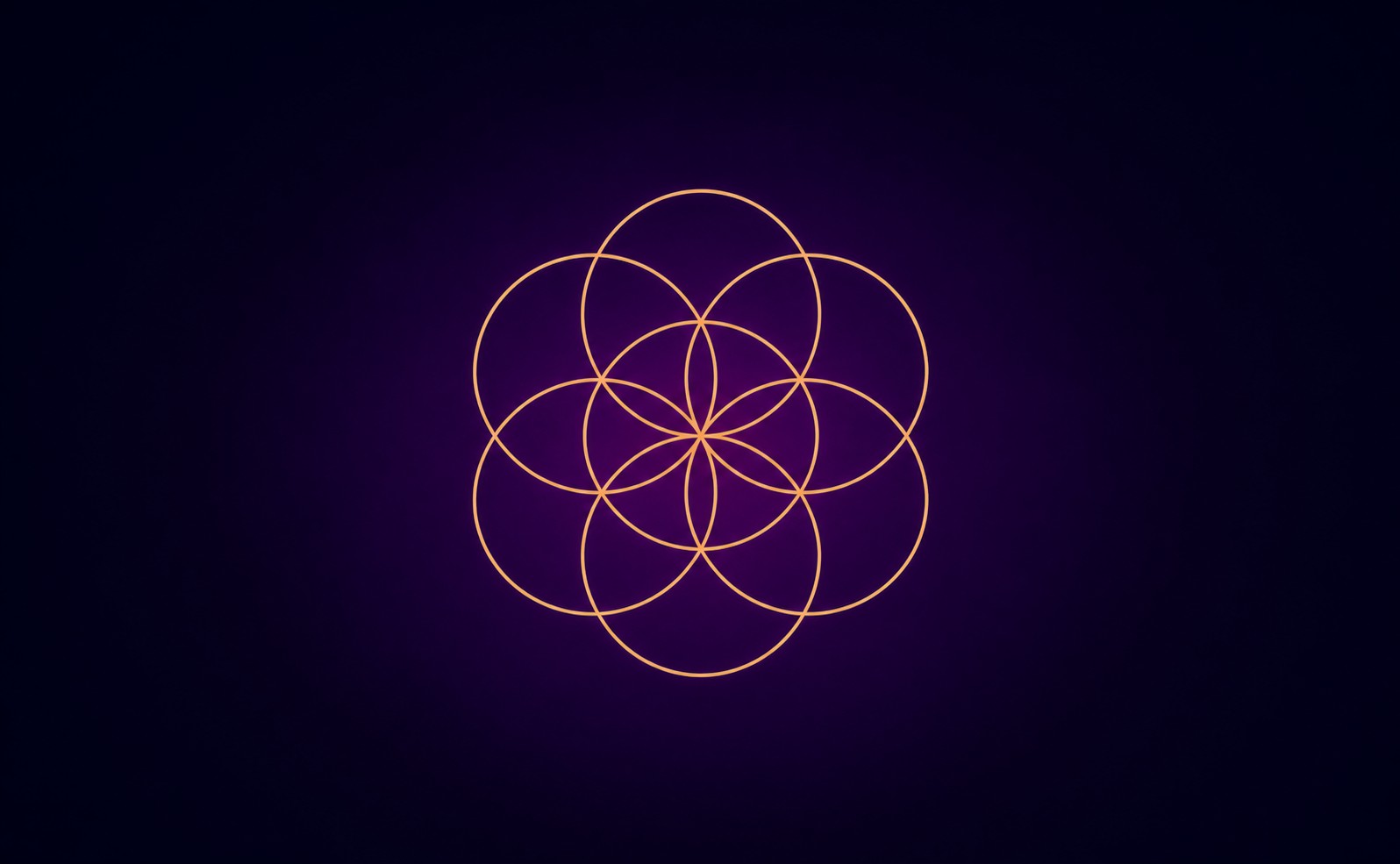
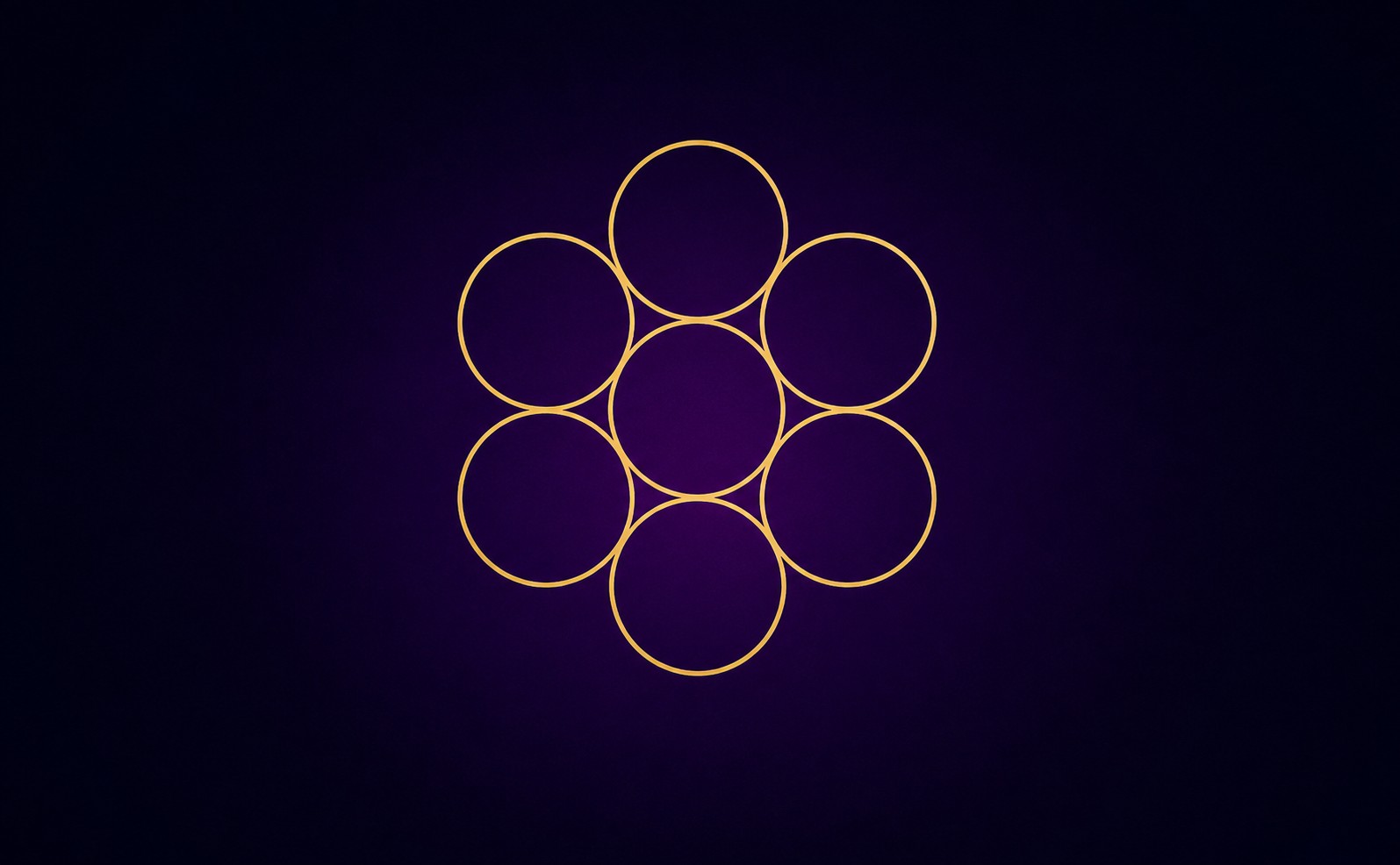
From relationship, pattern begins to multiply. One circle becomes surrounded by six circles of equal size, each arranged symmetrically around the same centre. Together they form the seven-circle pattern commonly known today as the Seed of Life.
Simple enough to construct with a compass, the pattern possesses sixfold rotational symmetry. Each new circle participates in the others, creating an ordered field of intersections, petals and repeating relationships.
This is the geometry of unfolding: One centre remains. Six circles gather around it. Unity has not disappeared, it has begun to multiply.
The Point gave us presence. The Circle gave us wholeness. The Vesica Piscis gave us relationship. The Sacred Third revealed emergence through relationship. And now the Seed of Life introduces repetition, pattern and unfolding. A geometric language is beginning to grow.
The Seed Contains the Pattern
There is something profoundly evocative about a seed. A seed does not visibly resemble the tree it may one day become. Yet within that small beginning lies the potential for roots, trunk, branches, leaves, flowers, fruit — and eventually more seeds.
The Seed of Life invites the same contemplation. Its seven circles don't literally contain everything that will follow, but geometrically they establish a repeating arrangement that can be continued outward. Extend the same construction and increasingly elaborate fields of overlapping circles emerge, including the larger pattern commonly called the Flower of Life.
The seed therefore becomes a beautiful metaphor for potential expressed through orderly unfolding. Nothing needs to leap immediately from simplicity into complexity. One relationship is repeated. Then repeated again. And complexity emerges.
Seven and the Language of Creation
Within modern sacred-geometry traditions, the seven circles of the Seed of Life have often been associated with the seven days of creation described in Genesis. This is a symbolic correspondence rather than an established ancient meaning of the seven-circle figure. The association nevertheless offers a compelling contemplative reading: creation not as a single completed event, but as a sequence — one stage giving rise to another.
Seven itself has accumulated rich symbolic meanings across many traditions and systems: seven-day weeks, seven classical celestial bodies in ancient astronomy, seven notes within the familiar Western diatonic scale, and, in some later yogic systems, seven principal chakras.
These traditions arose in different cultures and historical contexts. They need not derive from one universal hidden doctrine in order for their resonances to invite contemplation.
Within The Geometry of Souls, seven becomes another way of considering completion through unfolding. Not everything appears at once. Creation proceeds.
Where We Encounter Its Echo
The seven-circle arrangement demonstrates relationships that genuinely belong to geometry: equal radius, repeated intersection, radial symmetry and sixfold organisation. Similar principles — though not necessarily the exact Seed of Life pattern — appear throughout nature.
Sixfold symmetry appears dramatically in snowflakes and crystals. Hexagonal organisation emerges in honeycomb and other efficient packing systems. Radial arrangements occur in flowers and many living structures. These are not evidence that nature is consciously reproducing a sacred symbol. Rather, both the Seed of Life and natural forms can arise from underlying geometric relationships, and that is beautiful in its own right. Renditions of The Seed of Life can be found throughout the world, and through the ages.
We don't need to know that every maker attributed the same spiritual meaning to the form. The geometry itself survives. And we are free to encounter it anew.
Within The Geometry of Souls
Here, the Seed of Life represents the moment when possibility begins to develop a pattern. The seed does not yet reveal the whole garden. It doesn't need to. It carries enough...
One circle.
Another.
Another.
Relationship repeated until pattern appears. Perhaps creation often happens this way. Not through knowing the finished form in advance, but through allowing one true movement to lead naturally to the next.
Also, seven becomes another way of considering completion through unfolding. Not everything appears at once. Yet 'Creation' proceeds.
This is the geometry of unfolding.
This is Source, this is Love - as the seed carrying within itself the possibility of what it may become.
How to Work With the Seed of Life
Rest your gaze upon the compact seven-circle form.
Rather than trying to imagine everything it might eventually become, notice what is already present.
A centre.
Relationship.
Repetition.
Pattern.
If you are beginning a project, entering a new chapter of life,
or standing before something whose eventual form you cannot yet see,
allow the Seed of Life to become a meditation on beginning without needing to know the ending.
Ask quietly:
What is the next natural unfolding?
Not the tenth step.
Not the finished form.
Simply the next circle.
And notice what arises.
The Egg of Life
The Egg of Life
The Geometry of Embodiment
The Sacred Third introduced emergence through relationship. Now geometry begins to acquire depth. The circle becomes sphere. Pattern becomes spatial. Relationship begins to take form.
Within the language of sacred geometry, the Egg of Life marks a profound transition: from pattern into volume, from relationship into structure, from the suggestion of form into embodiment.
Often represented as an arrangement of spheres in three-dimensional relationship, the Egg of Life invites a compelling comparison with one of nature's most extraordinary processes — the transformation of a single fertilised cell into a multicellular living form.
This is the geometry of becoming: One becomes two. Two become four. Four become eight. Multiplicity emerges from unity. Relationship becomes structure. Structure begins to become form.
The Geometry of Embodiment
After fertilisation, a human embryo undergoes successive divisions known as cleavage. The cells produced by these divisions are called blastomeres. Around the eight-cell stage, another important transformation begins: the blastomeres increase their contact with one another and begin a process known as compaction, gradually organising themselves into a more cohesive whole.
The resemblance between these early cellular clusters and the spherical forms contemplated within sacred geometry is compelling. But resemblance is not identity. The cells of a human embryo don't arrange themselves into one universally fixed, mathematically perfect Egg of Life configuration. Living geometry is dynamic.
Cells change shape, position and relationship as development proceeds. Compaction itself transforms their initially rounded forms. Perhaps this makes the correspondence more beautiful rather than less. Sacred geometry need not be a hidden diagram imposed upon biology. Instead, it can provide a language through which we contemplate what biology is visibly doing:
division without loss of unity;
multiplicity emerging from one;
relationship becoming structure;
structure becoming form.
The Egg of Life can therefore be understood not as a literal microscopic blueprint of the embryo, but as a symbolic geometry of embodiment — a contemplative echo of the extraordinary process through which one living cell becomes many.
Where We Encounter Its Echo
We encounter the underlying principles of the Egg of Life in cellular division, sphere packing, three-dimensional geometry, and wherever simple relationships multiply into increasingly complex structures.
Its association with embryonic development is particularly evocative because both invite contemplation of the same extraordinary transition: one becoming many without ceasing to belong to one whole.
The Egg of Life also belongs to the modern vocabulary of sacred geometry. Claims connecting the pattern specifically to ancient knowledge of embryology, musical proportions, or a universally recognised ancient symbolic system, may or may not be so. Interpretations are widely repeated in contemporary sacred-geometry literature without established archaeological or scientific evidence. We don't need them to be to appreciate what we already know.
The observable phenomenon is already astonishing. A human body begins with a fertilised cell. That cell divides. Again. Again. And from the relationships established through those early divisions eventually emerge tissues, organs, hands, eyes, a beating heart — an entire embodied human being. Science can describe the mechanisms. Sacred geometry can invite us to contemplate the pattern. And the mystery remains immense.
Within The Geometry of Souls
Here, the Egg of Life represents the movement from relationship towards embodiment. Something that existed as possibility begins to occupy space. The flat circle becomes the sphere. The pattern acquires depth. The abstract begins to suggest the embodied. And so the Egg becomes a threshold. Not yet the fully differentiated body or the completed form.
But something has begun.
Within The Geometry of Souls, this is the moment when the One does not disappear as the Many emerge.
Instead, multiplicity becomes another expression of unity. One becomes many. The many enter into relationship. And through relationship, form begins to arise.
This is the geometry of embodiment.
This is Love, this is Source — as the One becoming the Many, while the Many remain within the One.
How to Work With the Egg of Life
Bring your attention to the clustered spheres of the Egg of Life.
Begin with one.
Then allow your awareness to move outward towards the others.
Rather than seeing separate objects, notice the relationships between them.
One. Two. Four. Many.
Imagine, for a moment, that something in your own life is beginning to take form.
It may be an idea, a relationship, a creative work, or simply a new understanding.
You don't need to know what its completed form will become.
Ask quietly:
What is beginning to take form?
And then:
What does it need in order to become embodied?
Remain with the questions without requiring an answer.
Notice what arises
The Flower of Life
The Flower of Life
Infinite Potential
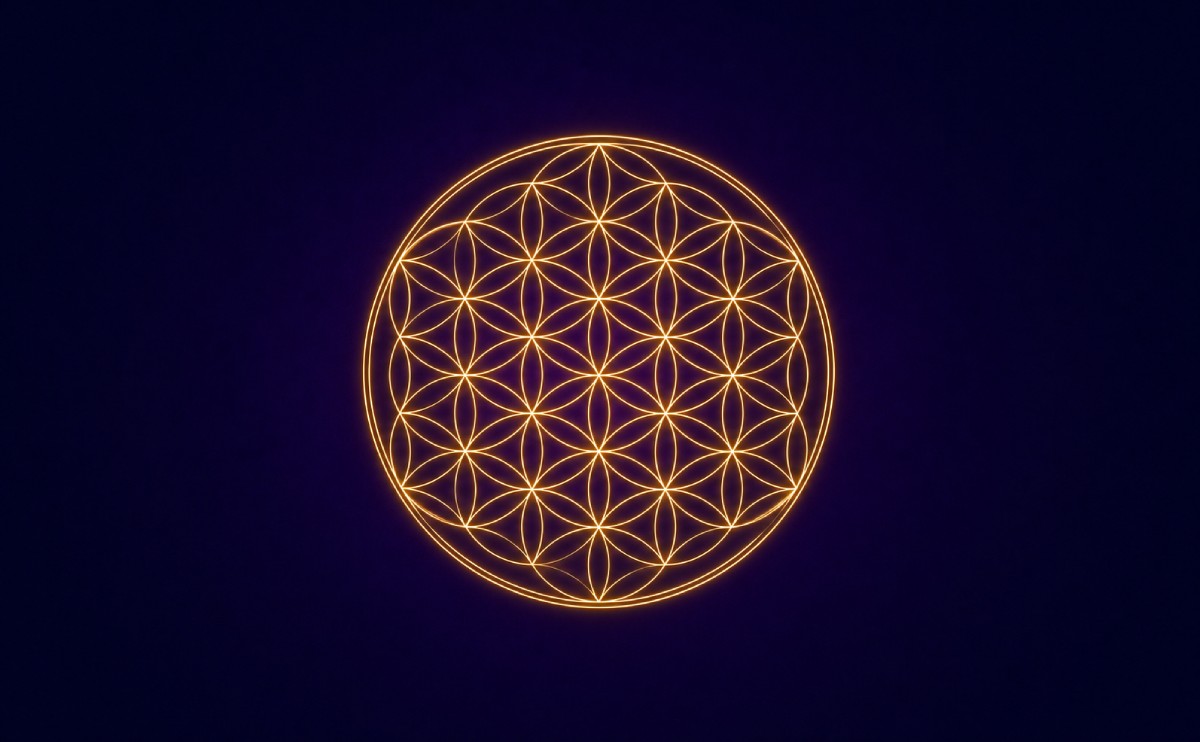
Continue the unfolding of the Seed of Life. Circle follows circle. Each is equal. Each enters into relationship with the circles around it. As the pattern expands outward, something remarkable appears: increasing complexity generated through the repetition of one extraordinarily simple relationship.
This is the Flower of Life.
This is the geometry of interconnected unfolding: One circle becomes many. Each remains whole. Each overlaps with others. Every new circle participates in the larger pattern. Simple repetition creates increasing complexity. And yet the original relationship is never lost.
The Seed of Life introduced unfolding. The Flower of Life reveals what happens when that unfolding continues. Pattern becomes field. Relationship becomes network. The individual circle remains visible, yet it now participates in something larger than itself.
The Geometry Within the Flower
The Flower of Life is formed from equal overlapping circles arranged with sixfold symmetry. Its apparent complexity arises from a remarkably simple geometric rule. Within its intersections we repeatedly encounter the Vesica Piscis and the six-petalled rosette already implicit in the Seed of Life. Look more closely and the eye begins to discover triangles, hexagons, radial axes, petals and repeating relationships. Some forms are explicitly present. Others emerge when selected centres and intersections are connected.
The Flower of Life does not literally contain every form in existence, nor can we establish it as a physical blueprint from which the universe is constructed. Rather, it provides a rich geometric field from which many further constructions can be explored. And perhaps that's more interesting. Simple beginnings don't need to contain the finished universe in miniature. They need only make complexity possible.
Where We Encounter Its Echo
Overlapping-circle patterns have appeared in art and ornament across different historical periods and cultures. A well-known example occurs at the Osirion at Abydos in Egypt, and related sixfold circle patterns are documented in other ancient artistic traditions. But care is needed when interpreting these appearances. The people who created them didn't necessarily call the pattern the Flower of Life. Nor can we assume that different cultures attributed the same spiritual meaning to similar geometric forms. Visual similarity does not, by itself, establish a single teaching transmitted unchanged across cultures. We're going to take a closer look at this idea further down the road in Cultural Patterns.
What these surviving patterns do demonstrate in our 3-dimensional physical world is something more fundamental: Human beings, separated by geography and time, repeatedly discovered beauty and possibility in circles, symmetry, repetition and intersection. The geometry was available to anyone willing to draw one circle — and then another.
Within The Geometry of Souls
Here, the Flower of Life becomes a meditation upon interconnection and possibility. Each circle may be contemplated as a whole being. Each intersection as relationship. The individual remains visible within the greater field. One relationship leads to another. And from repeated acts of meeting, something appears that no isolated circle could produce.
This doesn't require us to claim that the universe is literally constructed according to the Flower of Life. Instead, the geometry invites a quieter question: What can this pattern teach us about the relationship between the One and the Many?
Perhaps individuality and interconnectedness are not opposites and we can remain centred within ourselves while participating in something vastly larger. Complexity does not always require complicated beginnings. Sometimes it begins with one simple relationship — repeated. Expanded. Allowed to flower.
This is the geometry of interconnected possibility.
This is Source, this is Love — as relationship flowering into an ever-expanding field.
How to Work With the Flower of Life
Allow your gaze to rest softly upon the whole pattern.
Do not immediately count the circles or search for hidden forms.
First, simply experience the field.
Then allow your attention to move between one circle and the larger pattern surrounding it.
Notice how naturally perception can shift: one circle, many circles, one pattern.
You might then ask:
Where am I the circle?
Where am I the field?
Where does my life intersect with the lives around me?
There is no particular response you need to experience.
Simply allow the geometry to become an object of contemplation.
Notice what arises.
The Torus
The Torus
Eternal Circulation
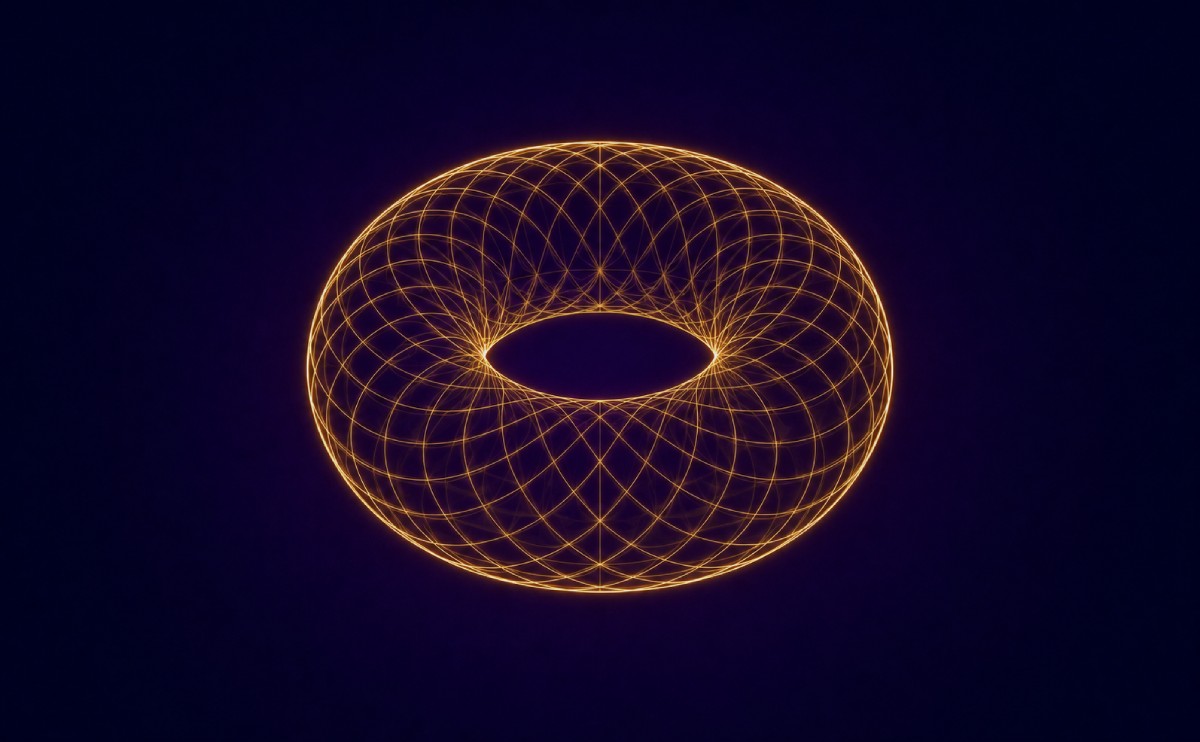
The Circle introduced wholeness upon a plane. Now allow geometry to acquire depth. Imagine a circle revolving around an axis outside itself. As it moves through space, it generates a three-dimensional form: the Torus.
Familiar in appearance as a ring or doughnut-shaped surface, the torus introduces another profound idea into our unfolding language: return. This is the geometry of circulation.
Movement can travel around the form and return to where it began. The surface is continuous. There is no edge at which the geometry simply stops. Inner and outer belong to one uninterrupted form. Movement around the torus suggests circulation rather than departure. Something goes forth — and returns.
The Geometry of Return
Mathematically, a standard torus can be generated by rotating a circle around an axis lying in the same plane but outside that circle. This simple construction produces a form with remarkable continuity.
Unlike a sphere, the torus possesses a central opening. Its geometry therefore invites us to contemplate not only centre and circumference, but passage, circulation and return.
The geometry itself does not prescribe an energy flow. But when lines of flow are mapped around toroidal forms, they can create an evocative visual language: outward and inward, expansion and return, giving and receiving. Within The Geometry of Souls, this becomes the heart of the Torus.
Where We Encounter Its Echo
Toroidal forms and toroidal components genuinely occur in mathematics, physics and nature, but they appear in different ways and should not all be treated as manifestations of one universal structure.
Smoke rings and vortex rings provide familiar examples of toroidal organisation in fluid motion. Toroidal magnetic fields are important in plasma physics and magnetic-confinement devices where magnetic-field configurations are deliberately organised around toroidal geometries.
Earth's magnetic field provides a more nuanced example. At the surface and through much of the surrounding magnetosphere it is primarily described as a dipole field, with field lines forming continuous loops around the planet. Within Earth's conducting interior, however, geodynamo processes also generate significant toroidal magnetic-field components.
The human heart likewise produces measurable electrical and magnetic activity. The magnetic field generated by cardiac electrical activity can be detected using magnetocardiography. This is extraordinary in itself. We don't need to describe the entire human heart field as a perfect torus in order to contemplate the relationship between heart, rhythm, circulation and flow.
Within The Geometry of Souls
Here, the Torus becomes a meditation upon Love as circulation. Love moves outward. Love receives. Love returns. Love moves again. Not as a scientific law of energy exchange, but as a contemplative principle: What if giving and receiving belong to the same movement?
The Torus offers a form in which outward movement need not mean permanent departure. Return need not mean regression. Giving need not imply disappearance. The journey outward and the journey inward can belong to one continuous process.
This is particularly important within The Geometry of Souls, because Love is not imagined here merely as emotion. Love is relationship. Participation. Exchange. Movement between self and other without requiring either to disappear. And so the Torus becomes one of our most powerful symbols for Love in motion. Not because mathematics tells us that the torus is unconditional love, but because its continuous geometry gives us a form through which unconditional love can be contemplated.
Give.
Receive.
Release.
Return.
And begin again.
This is the geometry of eternal circulation.
This is Life, this is Love, this is Source — giving and receiving within one continuous flow.
How to Work With the Torus
Bring your awareness first to your breath.
Notice the inhale.
Notice the exhale.
Neither needs to compete with the other.
Now imagine a gentle line of movement travelling upward through your centre.
Allow it, in your imagination, to arc softly outward, descend around you,
and return towards the centre again.
There is no need to believe that you are observing a literal energy field.
Simply use the toroidal form as a contemplative image for circulation.
As you breathe, notice:
receiving, giving, returning.
If you are feeling depleted, you might ask:
Where in my life am I giving without receiving?
Or:
Where am I receiving without allowing something to flow onward?
Allow the geometry to become a meditation upon balance rather than a prescription for achieving it.
Notice what arises.
Infinity
Infinity
Beyond The Boundary
The Torus introduced circulation. Movement goes forth. Movement returns.
And yet another question now arises: What if there's no final boundary at all?
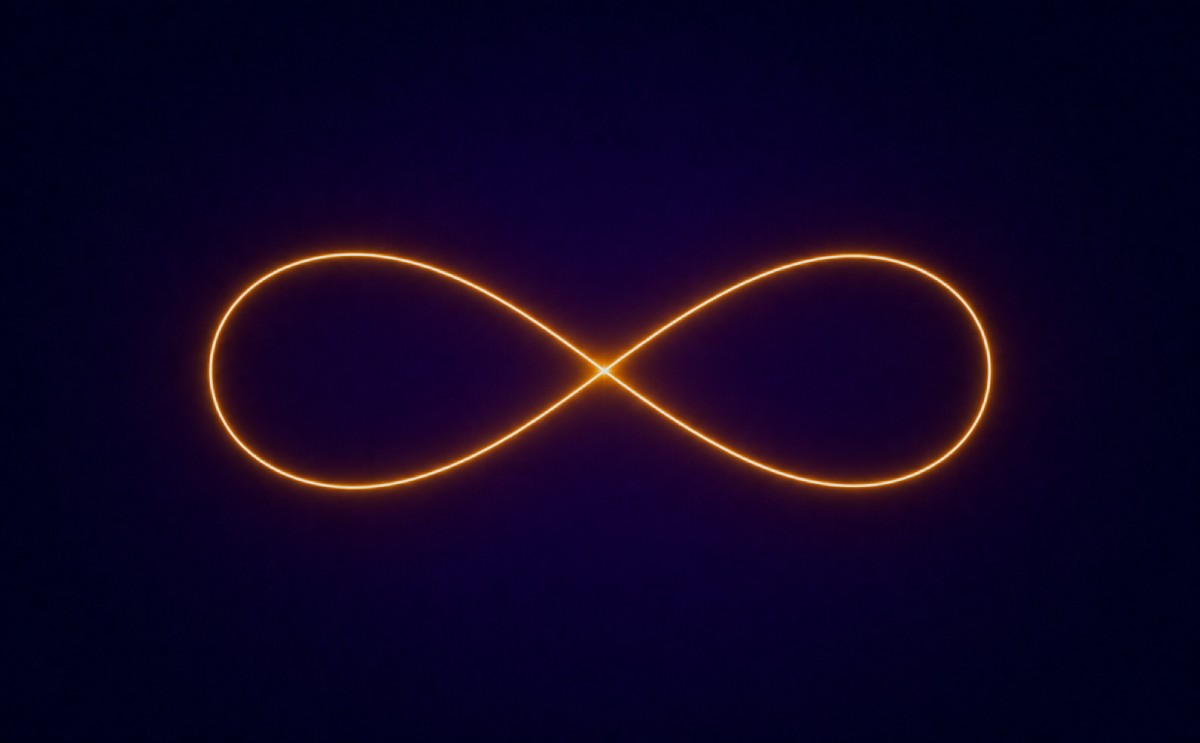
Infinity is not a shape, an object, or an unimaginably enormous number. It's a mathematical concept describing something without finite bound or end. And yet human beings have given that elusive idea a remarkably simple symbol: ∞
A single continuous line appears to cross itself, opening into two balanced loops. Follow it with the eye and there seems to be nowhere at which the journey must stop. This is the geometry of continuation; there is no final destination, outermost number, or last step. Every apparent completion can become another beginning. Infinity asks the mind to contemplate something it can describe mathematically but can never finish counting.
The Mathematics of Infinity
Infinity behaves differently from ordinary numbers. If we begin counting: 1, 2, 3, 4, 5... there is no largest counting number waiting at the end. Whatever number we reach, another can always follow. This doesn't mean that somewhere there exists an enormously distant number called infinity. It means the process has no finite endpoint.
Mathematics contains several precise ideas of infinity, and modern mathematics reveals something even more surprising: infinite collections need not all have the same size. The natural numbers form an infinite set, while other infinite sets can be larger in a mathematically rigorous sense. Infinity is therefore not simply “very large", it challenges our ordinary intuition about number, boundary and completion.
The Symbol
The familiar infinity symbol, ∞, entered mathematical notation through the work of English mathematician John Wallis, who used it in 1655. Its exact inspiration remains uncertain.
The figure-eight-shaped mathematical curve known as the lemniscate of Bernoulli came later. Jacob Bernoulli described the curve in 1694 and named it from a Latin word associated with a ribbon.
The infinity symbol and the lemniscate may look closely related, but they are not mathematically identical ideas. One is a symbol, the other is a curve, and infinity itself is something larger than either representation. No drawing can contain infinity, the symbol can only point towards it.
Where We Encounter Its Echo
Infinity appears throughout mathematics; in number systems, infinite sequences and series, limits, geometry, calculus and the study of infinite sets. But when we move from mathematics into the physical universe, greater care is needed. A horizon may appear endless. The stars may seem innumerable. A repeating pattern may suggest continuation without end, but appearance is not proof of physical infinity. We don't need to believe that everything in nature is literally infinite in order to experience what the idea awakens within us.
Standing beneath a night sky, looking towards a distant horizon, or contemplating a pattern that could theoretically continue beyond the page may all bring the mind towards the same threshold: Where does it end? And then: Must it end at all?
Within The Geometry of Souls
Here, Infinity becomes a meditation upon that which can't be contained by a final boundary. Until now, our geometries have created forms. The Point established presence. The Circle established wholeness. Relationship created new fields. Pattern unfolded. Form became embodied. And the Torus introduced circulation and return. But Infinity asks us to release the expectation of completion.
Conceivably, consciousness can't be understood entirely through boundaries, and Divine Love can't be exhausted by any single expression of it. Maybe 'becoming' does not require a final destination. Within The Geometry of Souls, Infinity doesn't prove eternal consciousness, reincarnation, or an infinite universe. It offers something quieter: a form through which we can contemplate continuation beyond what we can presently see or know.
And here lies a beautiful paradox. We draw a finite symbol to contemplate the infinite. The line fits upon the page but what it represents does not. This is the geometry of continuation beyond boundary. This is Divine Love expressing as possibility without a final horizon.
How to Work With Infinity
Bring your gaze to the infinity symbol.
Choose any point upon its line.
Follow the curve slowly with your eyes.
Around one loop.
Through the centre.
Around the other.
And back again.
There is no prescribed place to begin.
There is no required place to stop.
After several journeys around the form, allow your attention to rest upon the crossing point at its centre.
Notice the relationship between movement and return.
Then ask quietly:
What in my life have I mistaken for an ending that may actually be a transition?
Or simply:
What lies beyond the boundary of what I currently know?
No need to search for an answer.
Allow the question itself to remain open.
Notice what arises.
The Möbius Strip
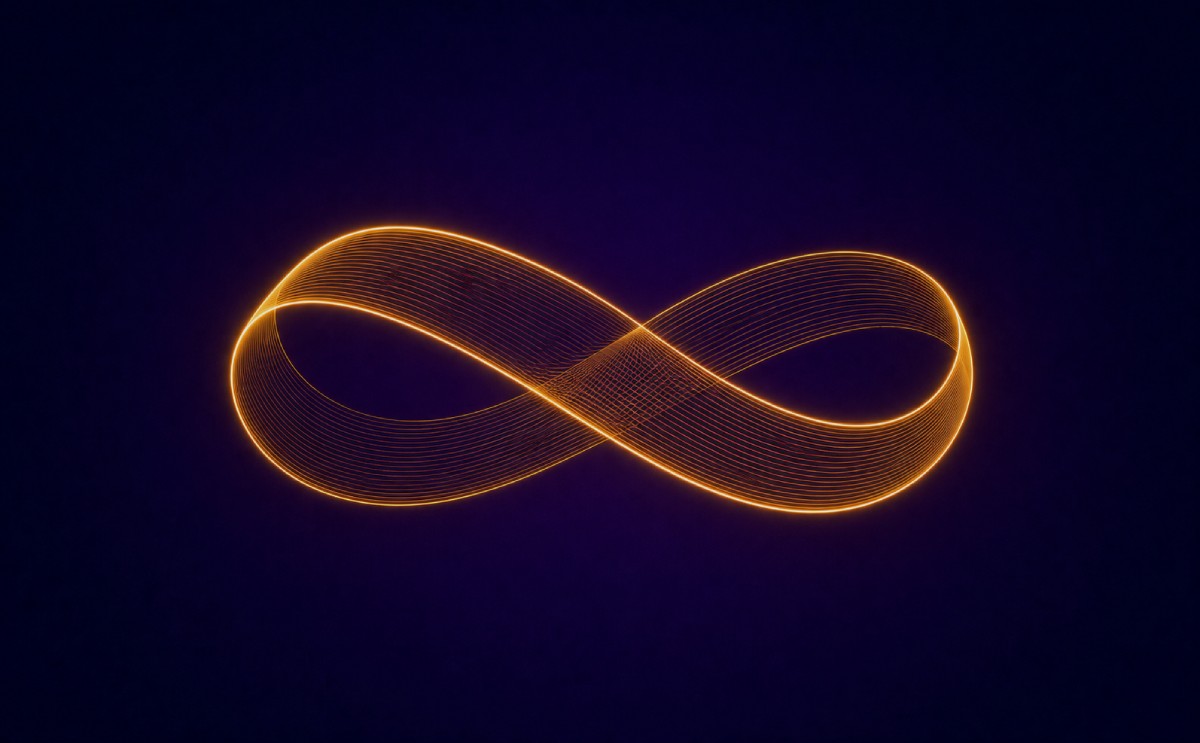
The Möbius Strip
The One Sided Journey
Infinity invited us beyond the idea of a final boundary. Now the Möbius Strip asks something stranger: What if two sides are actually one?
Take a simple strip. Give one end a half-twist. Join the two ends together and something remarkable appears: the Möbius Strip.
What began as a surface with two sides has become a continuous surface with only one side and one boundary edge. Place your finger anywhere upon its surface and begin tracing a path. Continue long enough and you will travel through what appeared to be both sides of the strip — without ever crossing an edge. Eventually, you return to where you began. This is the geometry of continuity.
What appears divided may belong to one continuous whole. Inside and outside become difficult to separate. Beginning leads into ending. Ending returns towards beginning. A twist transforms the relationship of the entire surface. And a journey that seems to have taken us somewhere else ultimately reveals that we never left the same continuous field.
The Geometry of the Möbius Strip
The Möbius Strip is one of mathematics' simplest examples of a non-orientable surface. Ordinary surfaces have two distinguishable sides. A sheet of paper, for example, has a front and a back. But give that sheet a half-twist before joining its ends and those apparently separate sides become continuous. There is no globally consistent way to designate one side as permanently “inside” and the other as permanently “outside”. The surface has become one-sided.
Its boundary is equally surprising. Trace the edge of an ordinary ring-shaped strip and you encounter two separate boundary loops. Trace the edge of a Möbius Strip and you discover only one continuous boundary. The mathematics does not merely symbolise unity - the surface genuinely possesses these topological properties. That is what makes it so extraordinary.
A Geometry Discovered Twice
The Möbius Strip entered mathematics in the nineteenth century. It's named after German mathematician and astronomer August Ferdinand Möbius, who described the surface in 1858. But mathematician Johann Benedict Listing independently discovered the same property around the same period — apparently slightly earlier. Both were working within the emerging field that would become known as topology: the study of properties that remain unchanged when forms are continuously stretched, bent or deformed without being cut or joined.
The Möbius Strip therefore belongs not to an ancient sacred-geometric tradition, but to relatively modern mathematics. Its contemplative meaning came later. And once again, that doesn't diminish it, but it makes the encounter even more interesting. A mathematical object discovered through rigorous investigation can still open philosophical and spiritual questions its discoverers did not need to intend.
Where We Encounter Its Echo
Unlike circles, spirals or branching structures, perfect Möbius strips don't simply appear everywhere in nature. But the topology has found remarkable applications in human design. Möbius-shaped conveyor belts and continuous-loop belts can distribute wear across a larger surface. The form has appeared in sculpture, architecture, jewellery, graphic design and engineering. It has also become one of mathematics' most recognisable visual symbols — particularly where artists and thinkers wish to explore continuity, paradox, transformation or interconnectedness. And perhaps its most powerful demonstration requires nothing more sophisticated than paper, scissors and tape.
Make one yourself. Draw a line along its centre without lifting your pen. Eventually the line returns to its beginning having travelled across the entire surface. No metaphysical claim is required. The geometry performs its own revelation.
Within The Geometry of Souls
Here, the Möbius Strip becomes a meditation upon apparent separation within underlying continuity. Human perception divides - inner and outer, self and other, beginning and ending, matter and spirit, known and unknown. We use distinctions because distinctions help us navigate experience.
But the Möbius Strip gently unsettles the assumption that every distinction represents an absolute separation. Perhaps some apparent opposites belong to a larger continuity we can't perceive while standing upon only one part of the journey. Move far enough around the Möbius Strip and what appeared to be the “other side” becomes the very surface beneath you. Nothing magical has occurred but our understanding of the surface has changed.
And this gives The Geometry of Souls a beautiful question:
What if some of the opposites we experience are different orientations of something whole? Not that every difference should be erased or that every contradiction is secretly identical, but perhaps wholeness can contain distinctions without requiring separation.
The Möbius Strip asks us to travel before deciding what belongs to which side, and perhaps that is part of wisdom: to remain curious long enough to discover the larger surface.
This is the geometry of continuity.
This is Divine Love — as apparent separation returning us to wholeness.
How to Work With the Möbius Strip
If possible, make one.
Take a strip of paper.
Before joining the ends, give one end a single half-twist.
Tape the ends together.
Now place a pencil somewhere near the centre of the strip and begin drawing a continuous line.
Do not lift the pencil.
Follow the surface.
Eventually you will return to the place where you began.
Then run your finger along the boundary.
Again, follow it until you return.
Allow the physical experience of the form to come before interpretation.
Then ask quietly:
Where in my life have I assumed there are two sides when there may be a deeper continuity?
Or:
What might become visible if I follow the whole journey before deciding what it means?
There is no conclusion you need to reach.
Simply follow the surface.
Notice where it takes you.
The Golden Spiral
The Spiral
Return Without Repitition
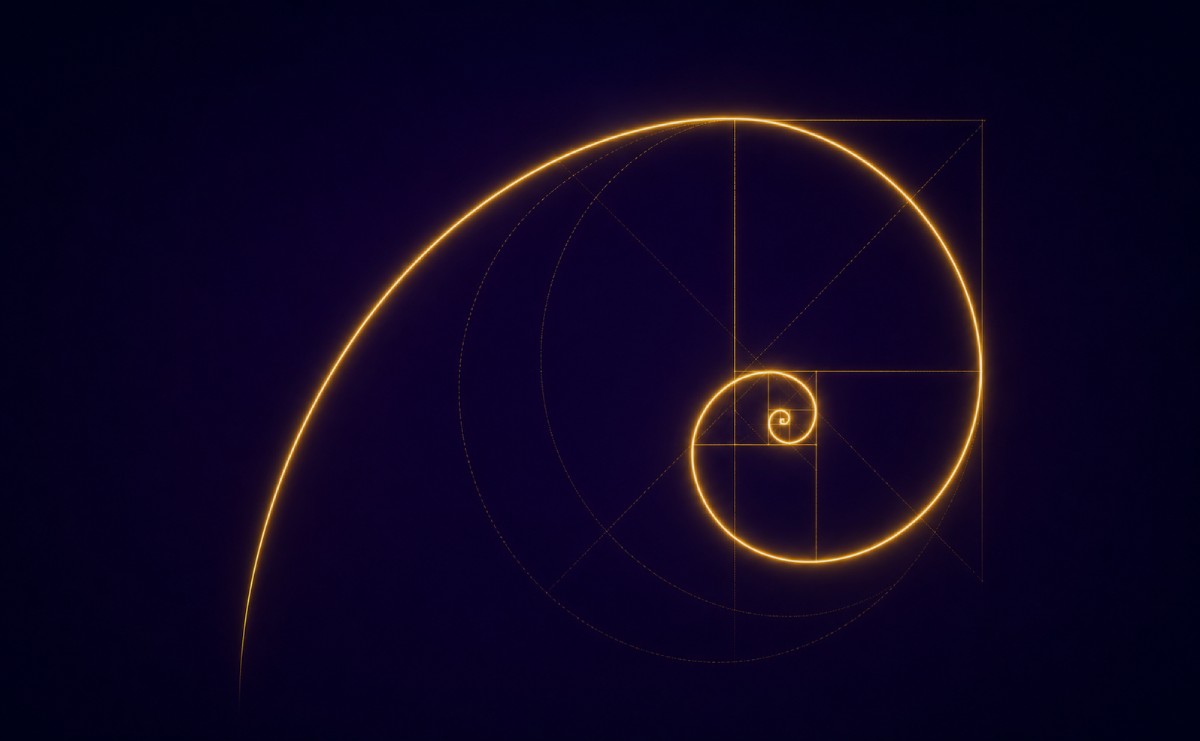
The Möbius Strip gave us continuity. Follow its surface and eventually we return to where we began. The Spiral introduces another kind of journey. We turn. We return towards a familiar direction. But we do not return to the same place. Distance and position have changed, and, the journey has changed us.
This is the geometry of transformation: Movement around a centre. Expansion or contraction. Return without exact repetition. Continuity without remaining still. A relationship between where we have been and where we are becoming. The Spiral reminds us that return doesn't necessarily mean going backwards. Sometimes we pass familiar territory from another place entirely.
The Geometry of the Spiral
There is no single mathematical form called the Spiral. Rather, spirals are a family of curves that wind around a point or axis while their distance from that centre changes according to a particular mathematical relationship. Different relationships create different spirals. In an Archimedean spiral, successive turns remain equally spaced. In a logarithmic spiral, the distance between successive turns increases geometrically as the spiral expands. And a golden spiral is one particular logarithmic spiral, associated with the golden ratio.
Other forms include the Fermat spiral, hyperbolic spiral and many more. They may resemble one another to the eye. However, mathematically, they are not interchangeable. This distinction will become especially important when we encounter Fibonacci. Not every spiral is a Fibonacci spiral and not every spiral in nature is a golden spiral. Visual resemblance alone doesn't establish an exact mathematical relationship. Yet across all these variations, one underlying idea remains compelling: the spiral combines rotation with change. Something turns while simultaneously moving inward or outward.
Where We Encounter Its Echo
Spiral and spiral-like forms appear abundantly in nature, although they arise through many different physical and biological processes. We encounter them in certain shells and horns, in unfurling ferns, tendrils and plant structures, in whirlpools and atmospheric systems, and in the arrangement of material within some galaxies.
Some plants organise leaves, seeds or florets in spiral patterns through developmental processes associated with phyllotaxis. Some shells grow in ways that approximate logarithmic spirals. Large rotating systems may develop spiral structures through entirely different forces. These forms may look related without being generated by the same mechanism, and that difference matters.
Nature doesn't appear to possess one hidden spiral template that it repeatedly stamps onto everything. Rather, spiral forms can emerge whenever rotation, growth, flow, packing, expansion or contraction interact in particular ways.
Perhaps the recurrence of the spiral is more interesting when understood this way - different processes discovering related geometries.
The Spiral Across Human Culture
Long before modern mathematics classified different families of spiral curves, human beings were drawing spirals. They appear in prehistoric rock art, pottery, jewellery, architectural, ornament, and ceremonial objects across many regions of the world.
One celebrated example can be found among the Neolithic carvings at Newgrange, where spiral and triple-spiral motifs were carved into stone more than five thousand years ago. We can see the marks but
what we can't always recover with certainty is what they meant to the people who made them.
Modern interpretations often associate ancient spirals with birth, death, rebirth, the Sun, seasons, journeys, fertility or cycles of existence, and may indeed be meaningful- but the mystery need not be filled with certainty. Sometimes we can simply stand before an ancient spiral and acknowledge; someone made this. Someone returned to this form. And thousands of years later, we are still looking.
Within The Geometry of Souls
Here, the Spiral becomes a meditation upon transformation through movement.
Life contains cycles: Morning returns. Seasons return. Relationships return us to familiar questions. Old memories arise. Patterns reappear.
We may sometimes believe: I have been here before. But perhaps we haven't. Not exactly - because the person encountering the moment now is not precisely the person who encountered it before. Experience has entered the geometry. The Spiral therefore offers us an alternative to imagining life only as a circle. A circle returns to its chosen starting point. A spiral can pass through a familiar orientation while occupying a different position.
And so, within The Geometry of Souls return is not repetition. We may revisit grief with greater tenderness. Return to Love with greater capacity. Meet an old question with new understanding. Re-enter a familiar landscape carrying everything the journey has taught us.
Also - the Spiral doesn't promise that every cycle leads upward. Growth is not always linear. Transformation is not guaranteed merely because time has passed, but the form gives us a language for contemplating the possibility that repetition can become evolution when something changes through the journey.
And perhaps this is the Eternal Return: not an endless replay of what has already been, but another encounter with the familiar — from somewhere new. What returns is not what departed. It returns enriched by experience, expanded by Love, and transformed by the journey.
This is the geometry of transformation.
How to Work With the Spiral
Begin at the centre of a spiral.
Allow your gaze to follow the line slowly outward.
Do not hurry towards the edge.
Simply travel.
Notice that each revolution brings you around the centre again,
yet never quite to the same place.
Then reverse the journey.
Begin at the outer edge and travel inward.
Expansion.
Return.
Outward.
Inward.
Neither direction need be understood as better than the other.
Now bring to mind something that has returned in your own life.
A question. A relationship. A pattern. A place.
A feeling you thought you had already understood.
Ask quietly:
Am I truly in the same place — or am I meeting this from another turn of the spiral?
Then perhaps:
What has the journey added?
There is nothing you need to resolve.
Simply notice where you are on the spiral now.
The Fibonacci Curve
Fibonacci
Growth Through Relationship
The Spiral introduced transformation through movement. Now another pattern appears — not first as a shape, but as a sequence of numbers.
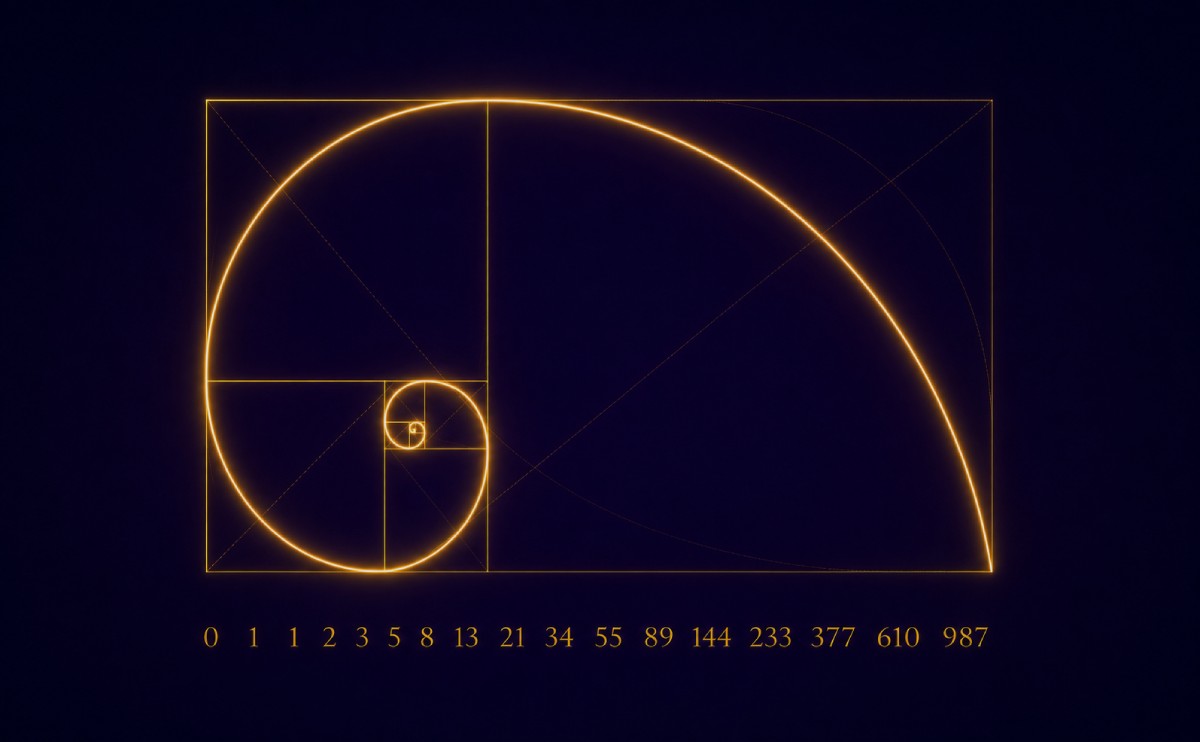
Begin simply: 0, 1, 1, 2, 3, 5, 8, 13, 21, 34, 55... Each new number arises by adding the two that came before it.
0 + 1 = 1
1 + 1 = 2
1 + 2 = 3
2 + 3 = 5
3 + 5 = 8
And onward. This is the Fibonacci sequence.
This is the mathematics of relationship: Each new term carries what came before. Nothing arises entirely alone. The present is formed through relationship with the past. A simple rule generates increasing complexity. And as the sequence continues, another remarkable relationship begins to emerge.
The Mathematics of Fibonacci
The Fibonacci sequence is defined by a recurrence; after the starting values, each term is the sum of the previous two. The sequence is named after the medieval mathematician Leonardo of Pisa, known today as Fibonacci, who described it in Liber Abaci in 1202 through a famous idealised problem involving the reproduction of rabbits. But Fibonacci did not originate the underlying number pattern.
Related sequences had already appeared in Indian mathematical traditions in the study of poetic metre, including work associated with scholars such as Gopāla and Hemachandra. This gives us another opportunity to be careful with history. A mathematical relationship may be known in more than one culture, for more than one purpose, before acquiring the name by which it later becomes widely recognised.
Fibonacci and the Golden Ratio
Something extraordinary happens as the sequence grows. Divide one Fibonacci number by the one immediately before it:
8 ÷ 5 = 1.6
13 ÷ 8 = 1.625
21 ÷ 13 ≈ 1.615
34 ÷ 21 ≈ 1.619
55 ÷ 34 ≈ 1.618
The ratios move closer and closer to a particular irrational number:
φ ≈ 1.6180339887...
This is the golden ratio. The Fibonacci numbers are not themselves the golden ratio. Rather, the ratios of successive Fibonacci numbers approach the golden ratio as the sequence continues. That distinction matters - sequence and proportion are related — but they're not the same thing.
Fibonacci, the Golden Spiral and the Fibonacci Spiral
Here is another important distinction. The Fibonacci sequence is not a spiral. A commonly drawn Fibonacci spiral is constructed by arranging squares whose side lengths follow Fibonacci numbers and drawing quarter-circle arcs through them. As those squares increase in size, the resulting curve provides a visual approximation associated with the sequence.
A golden spiral, however, is a particular logarithmic spiral whose growth is governed precisely by the golden ratio. The two become visually very similar as they expand. But approximation is not identity.
This is one of the places where popular sacred-geometry illustrations often blur several beautiful mathematical ideas into one. We don't need to. Each becomes more interesting when allowed to remain precisely what it is.
Where We Encounter Its Echo
This is where Fibonacci's relationship with nature becomes genuinely fascinating. Some of the clearest examples occur in phyllotaxis — the arrangement of leaves, florets and other plant organs. In sunflower heads, pinecones and other plants, visible spirals running in opposite directions frequently occur in numbers that are consecutive members of the Fibonacci sequence — for example, 34 and 55.
In spiral phyllotaxis, successive plant organs also commonly emerge at a divergence angle close to 137.5°, known as the golden angle. These patterns arise through developmental processes involving the positioning and growth of new plant structures. So there really is remarkable mathematics in the garden.
But not every flower has a Fibonacci number of petals. Not every shell follows the golden spiral. Not every galaxy is Fibonacci. And the human body does not conform everywhere to the golden ratio. Nature is richer and less obedient than that. Fibonacci patterns are one family among many. Their genuine appearances become more remarkable, not less, when we resist finding them where they are not.
Within The Geometry of Souls
Here, Fibonacci becomes a meditation upon growth through relationship. Each new term depends upon what preceded it. Yet it's not simply a repetition of either previous term. Something new emerges through their combination.
This carries forward the language we first encountered in the Vesica Piscis and the Sacred Third - relationship can be generative, but Fibonacci introduces another dimension - memory. What came before participates in what comes next. Within The Geometry of Souls, we might imagine our own lives in much the same way. We don't arrive at each moment untouched by what preceded it: Experience, relationship, Love, loss, and learning accompanies us. Yet the next moment need not simply reproduce the last. Something new can be created from what has already been lived.
And perhaps this is where Fibonacci meets the Spiral.
The Spiral told us: Return is not repetition.
Fibonacci now adds: Growth remembers.
The next expression carries something of what came before — while becoming something that has never existed before. This is the mathematics of growth through relationship.
How to Work With Fibonacci
Write down the beginning of the sequence:
0, 1, 1, 2, 3, 5, 8, 13...
Do not hurry through it.
For each new number, look back at the two that preceded it.
Notice the simplicity of the rule.
Then consider something currently growing within your own life.
Rather than asking only:
Where am I going?
Try asking:
What am I carrying forward?
What experience has prepared the ground?
What relationship has changed what becomes possible next?
What might be retained —and what need not be repeated?
You might then ask quietly:
What can arise from the relationship between where I have been and where I am now?
There is no mathematical formula for the answer.
That belongs to you.
Notice what arises.
The Cardioid
The Cardioid
The Geometry of The Heart
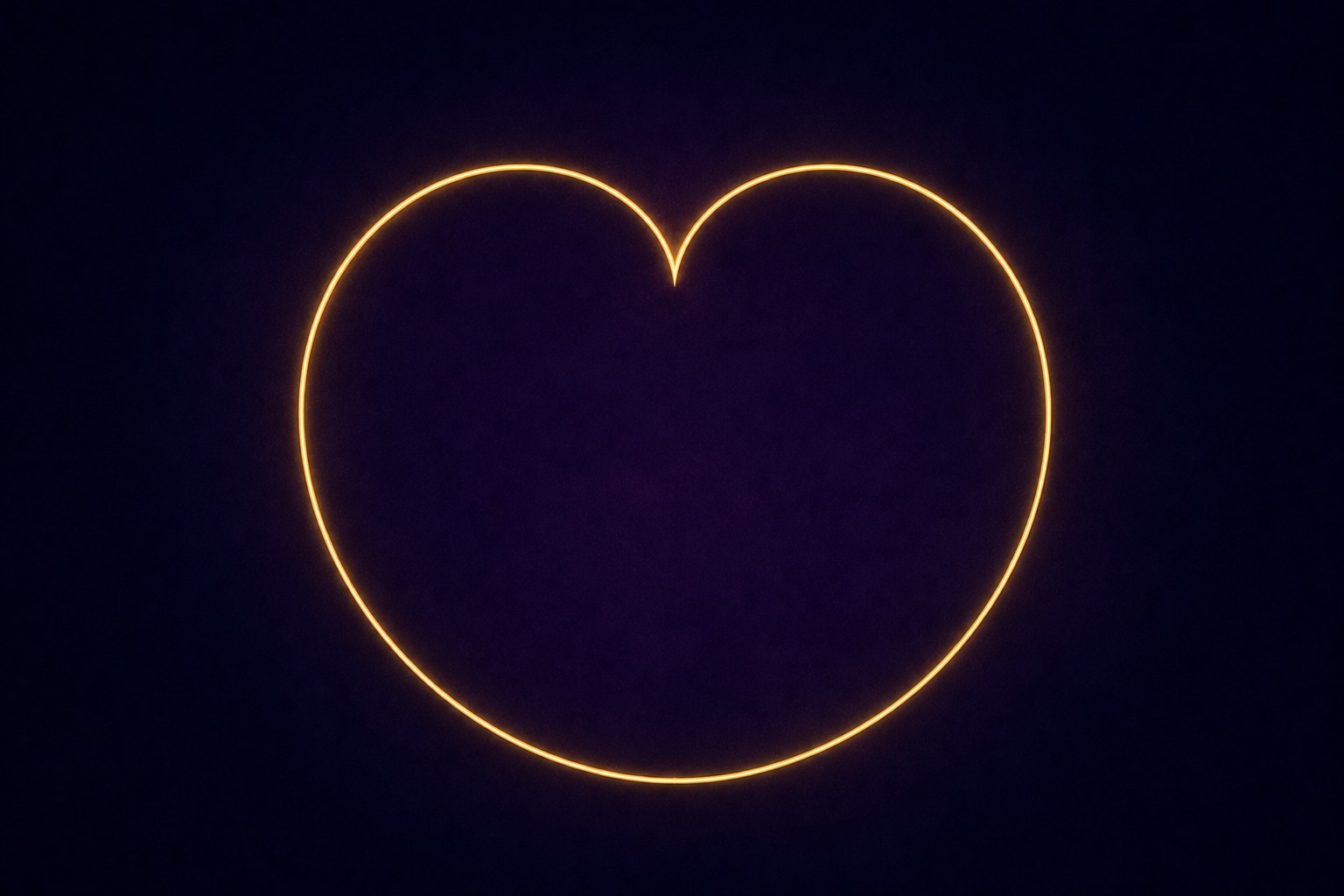
Fibonacci showed us how relationship can generate growth, and now the line curves inward. It gathers and meets itself at a single cusp, and an unmistakable form appears - the Cardioid. Its resemblance is immediate. A heart. Not the anatomical human heart, but the symbolic heart humans have drawn, recognised and carried through art and culture for centuries.
And remarkably, mathematics gives this heart-shaped curve its own precise identity. This is the geometry of gathering: A continuous curve. Two rounded arcs. One axis of symmetry. A single cusp where the curve meets itself. Movement outward. Movement inward. And a form that seems to gather everything towards one point.
The Mathematics of the Cardioid
The cardioid is a particular mathematical curve belonging to the family of curves known as epicycloids. Imagine one circle rolling around the outside of another circle of exactly the same size.
Choose a single point upon the circumference of the moving circle. As the circle rolls without slipping, that point traces a path through space. The path it creates is a cardioid. That simple relationship — one circle moving around another equal circle — creates the heart-shaped curve.
The cardioid can also be described by equations, including a particularly elegant polar form. But for our purposes, its geometric construction tells us something especially relevant; the curve emerges through relationship and movement. One circle alone does not trace the cardioid. It arises when one moves in precise relationship with another.
The Heart Within Mathematics
The name cardioid comes from words associated with the heart or “heart-shaped”. The mathematical name was introduced by Giovanni Francesco Melchiorre Salvemini, known as de Castillon, in 1741. The resemblance is visual rather than anatomical. A human heart is not a cardioid. Nor does the mathematical cardioid establish that the heart symbol itself arose from this geometry.
There are many mathematical curves capable of producing heart-like forms, but the correspondence remains irresistible; mathematics encountered a particular curve — and named it for the heart.
Where We Encounter Its Echo
The cardioid is not merely an invented decorative shape. It arises naturally within mathematical investigations of rolling circles, geometry and optics. One particularly beautiful example involves light. When rays originate from a point on the circumference of a reflective circle, the envelope formed by the reflected rays is a cardioid — a type of optical curve called a caustic.
This needs a little care because the bright curve commonly seen inside a coffee cup under roughly parallel illumination is usually associated with a related curve called a nephroid, not a cardioid. But under the appropriate geometry of light and reflection, the cardioid genuinely appears and this gives us something quietly beautiful; a heart-shaped curve can be traced not only through moving circles, but through reflected light. No metaphysical claim is required. The optics are already lovely.
Within The Geometry of Souls
Here, the Cardioid becomes a meditation upon the heart as a place of gathering and expression.
We have travelled through relationship: Emergence. Embodiment. Unfolding. Circulation. Infinity. Return. Growth. And now the journey arrives at the Heart.
The mathematics does not tell us that Love lives in a cardioid, or prove that consciousness is heart-shaped, or that Angels possess cardioid wings. Those belong to another layer of our exploration. But the form offers us something through which those ideas may be contemplated. Two circles in relationship can generate a cardioid. Light can trace a cardioid. A moving point can create a heart-shaped path. But within The Geometry of Souls, these mathematical facts become invitations rather than proofs.
Perhaps Love, too, is not simply something held. Perhaps it's something generated through relationship. Something that moves, that gathers, that radiates. Something that returns towards centre without remaining there. And perhaps this is why the Cardioid has become such a powerful form within this work - not because geometry proves Love — but because geometry has unexpectedly given Love a beautiful language.
The Heart becomes not merely a symbol, but a place of movement. This is the geometry of the Heart. This is Divine Love as relationship gathering itself into form.
How to Work With the Cardioid
Bring your gaze to the Cardioid.
Begin at its cusp.
Allow your attention to travel slowly outward along one curve.
Follow its fullness.
Continue around the form until the line begins returning towards the centre.
Eventually you arrive again at the cusp.
Now notice the whole.
Expansion.
Gathering.
Return.
You might bring your attention gently towards your own heart,
as a place humans have long associated with feeling, relationship and Love.
Ask quietly:
What is my heart gathering?
And perhaps:
What is my heart ready to express?
Do not require an answer.
Allow the questions to rest within the form.
Notice what arises.
The Cross
The Cross
The Sacred Centre
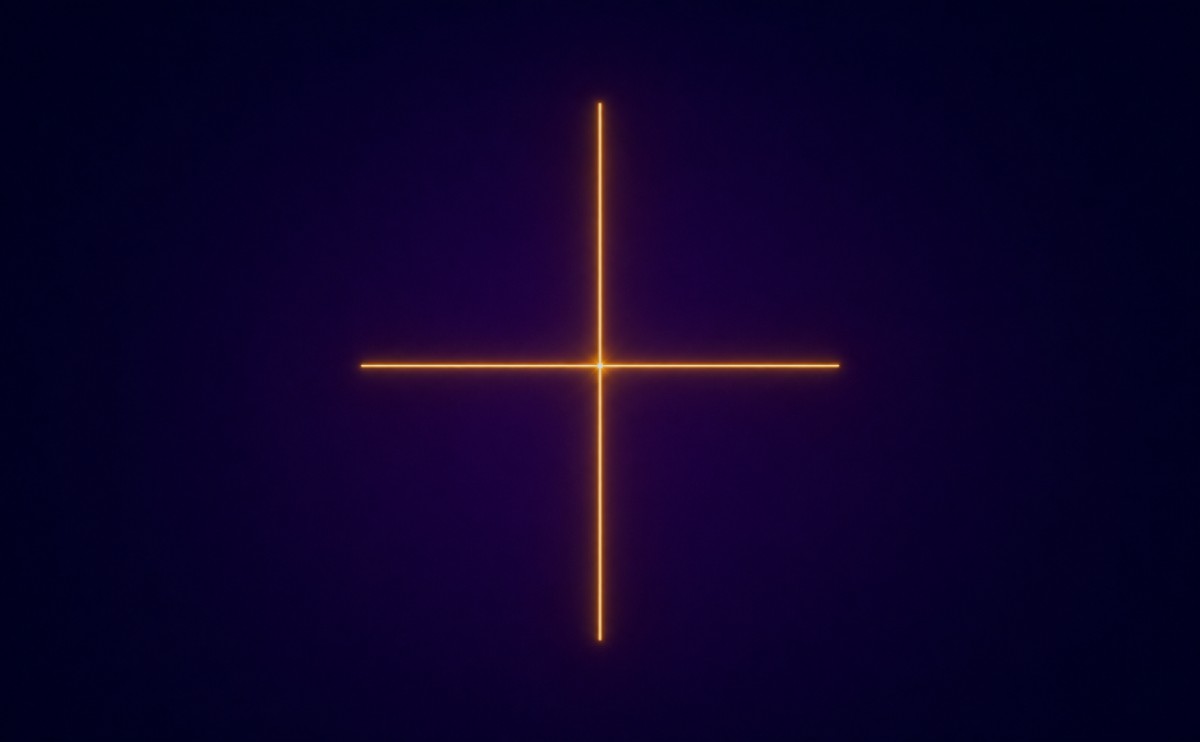
The Cardioid gathered movement into the symbolic form of the Heart. Now the geometry becomes extraordinarily simple. One line. Another line. They meet. At their intersection, a centre appears - the Cross.
Long before we ask what the Cross means, we can look at what its geometry does. One axis extends in one direction. Another crosses it. Four regions emerge around a common centre. Different directions are held within a single relationship. This is the geometry of intersection: Horizontal and vertical. Above and below. Left and right. Four directions. One meeting place. The Cross establishes orientation — and at the place where its axes meet, the centre.
The Geometry of the Cross
At its simplest, a geometric cross can be formed by two intersecting line segments. If they intersect at right angles, they establish two perpendicular axes. When the lines are equal in length and meet at their midpoints, the result is an equal-armed cross with fourfold rotational symmetry.
Other cross forms alter these proportions. The familiar Latin cross, for example, places the horizontal arm above the midpoint of the longer vertical axis. The Greek cross uses arms of equal length. Many other cross forms have developed within different cultures, religions and systems of symbolism. There is therefore no single universal geometry called the Cross. But beneath many of its variations lies the same elemental act - one direction meeting another. And where they meet, a point acquires a new significance.
The Point once represented origin. Now it becomes intersection.
Where We Encounter Its Echo
Cross-shaped and cruciform designs occur across many periods and cultures, carrying meanings specific to their contexts. Cross forms existed long before Christianity and appear in prehistoric art, ancient ornament, writing systems, astronomical and directional symbols, architecture and ceremonial objects.
Within Christianity, the Cross acquired a profoundly particular meaning through the Crucifixion of Jesus and became one of the tradition's central symbols — associated with sacrifice, suffering, redemption, death and resurrection. Other cultures have used cross-like forms differently. Some have represented directions. Some have marked celestial relationships or orientation. Some are decorative or architectural, and some belong to symbolic systems whose meanings can only be understood within the cultures that created them.
We should therefore resist saying: The Cross has always meant this. It hasn't. The form is ancient. Its meanings are many. And each deserves its own history.
The Four Directions
One of the simplest contemplations available within an equal-armed cross comes directly from its geometry. From the centre, four arms extend. North. South. East. West. Or, above, below, left, and right.
Many cultures have developed rich systems around four directions, often associating them with seasons, elements, stages of life, winds, colours or spiritual principles. Those correspondences vary substantially between traditions and should not be blended into a single supposedly universal ancient teaching. But the underlying spatial relationship requires no cultural claim.
Stand somewhere and face a direction. There is space before you. Space behind you. Space to either side. And beneath that experience lies something easily overlooked - you are standing somewhere. Orientation requires a point of reference. The Cross makes that relationship visible.
Within The Geometry of Souls
Here, the Cross becomes a meditation upon centre and intersection. Until now, much of our journey has moved: Circles expanded. Relationships formed. Patterns unfolded. The Torus circulated. Infinity continued. The Möbius Strip travelled. The Spiral transformed. Fibonacci grew. The Cardioid gathered. And now — we arrive at the centre. The Cross asks us to notice where different dimensions of experience meet.
Within The Geometry of Souls, the vertical axis may be contemplated as the relationship between above and below: the transcendent and the embodied; Spirit and Earth; the unseen and the manifest.
The horizontal axis may be contemplated as relationship across the plane of lived experience: self and other; giving and receiving; the individual and the world.
These are contemplative correspondences, not mathematical properties of the Cross. But where the two axes meet, something important happens. There is no longer only above and below. There is no longer only here and there.
There is: HERE. The centre. The place where vertical and horizontal encounter one another. The place where orientation becomes possible. And perhaps, within the language of this work, the Cross asks one of the simplest and most important questions of all: Can I remain at my centre while participating fully in the world? Not withdrawn from life or lost within it, but... Present. Centred. Connected vertically and horizontally.
The Point has returned, but it is no longer the Point we first encountered emerging from The Void. That Point knew only: I AM.
This Point has travelled through relationship, embodiment, pattern, circulation, infinity, transformation, growth and Heart. Now it stands at an intersection and says: I AM HERE.
This is the geometry of intersection and centre. This is Love — as presence finding its place within the whole.
How to Work With the Cross
Bring your gaze to a simple equal-armed Cross.
Begin at its centre.
Follow the vertical axis upward.
Return to centre.
Follow it downward.
Return.
Now move horizontally in one direction.
Return.
Then the other.
Return again.
Notice that every journey begins from the same place.
And every direction remains connected through it.
Bring your awareness gently to your own sense of centre.
You might ask:
Where am I?
Not geographically.
Not where you think you should be.
Simply:
Where am I within myself, now?
Then ask:
Can I meet the world from here?
Remain for a few moments at the intersection.
Notice what arises.
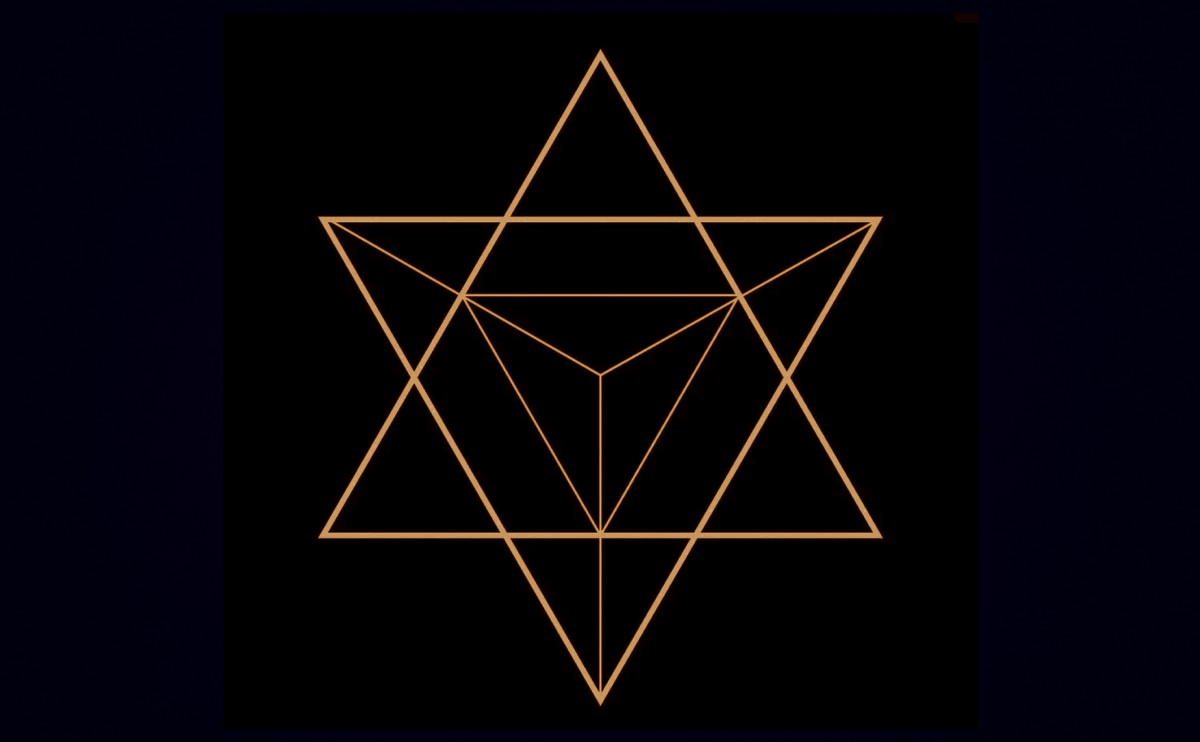
The Merkaba
The Merkaba
The Geometry of Interpenetration
The Cross brought us to the centre. Two directions met. Vertical and horizontal entered into relationship.
Now the geometry rises from the plane. The triangle becomes tetrahedron. One tetrahedron points upward and another points downward. The two pass through one another, sharing the same centre.
A three-dimensional star emerges - the Star Tetrahedron — the form widely known in contemporary sacred geometry as the Merkaba. This is the geometry of interpenetration: Two complete forms. One shared centre. One oriented upward. One oriented downward. Neither disappears into the other. Each passes through the other. And together they create a form that neither can create alone.
The Geometry of the Star Tetrahedron
Mathematically, the symmetrical compound of two regular tetrahedra is known as the stella octangula. The two tetrahedra occupy the same space in opposite orientations. Their eight outer vertices correspond to the eight vertices of a cube, while the region common to both tetrahedra forms an octahedron.
This makes the geometry far richer than its outer star-like appearance initially suggests: Tetrahedron. Octahedron. Cube. Different forms are already entering into relationship.
The name stella octangula was given by Johannes Kepler in the early seventeenth century, although the form was known earlier: Luca Pacioli illustrated a version in 1509, calling it the octaedron elevatum.
In modern sacred geometry, the wireframe star tetrahedron is frequently called the Merkaba. But here we need to make an important distinction.
Merkaba and Merkavah
The word Merkavah belongs to a much older and different tradition. The Hebrew merkavah means chariot and became associated with Jewish mystical contemplation of the divine throne-chariot described in the Book of Ezekiel. The ancient Merkavah tradition did not, on the historical evidence available to us, teach that this chariot was a pair of interpenetrating tetrahedra. The now-familiar identification of the Merkaba with a star tetrahedron, a human “light body”, counter-rotating fields, spiritual activation and dimensional travel are associated with other esoteric and sacred-geometry teachings, rather than being an established geometric teaching inherited directly from ancient Jewish mysticism.
The two traditions may be placed into dialogue by contemporary spiritual practice. But they should not be presented as historically identical. And, we still have the mystery of the ancient Mer-Ka-Ba; an expression meaning light-spirit-body to consider within Egyptian etymology.
This distinction matters. Not because it diminishes the modern spiritual symbolism — but because every tradition deserves to be allowed its own history, even though we may discover common denominators later on within this body of work.
Where We Encounter Its Echo
The star tetrahedron belongs firmly within the history of geometry. Its relationship with other regular solids is particularly beautiful: The eight outer vertices define a cube. The shared central region is an octahedron. And the whole figure itself is generated from two regular tetrahedra. So before we have even formally entered our exploration of the five Platonic Solids, three of them are already speaking to one another.
The form has also fascinated artists and geometers. M. C. Escher included stella-octangula forms in his 1948 wood engraving Stars and constructed a physical model of the solid.
What geometry establishes is already remarkable. What spiritual traditions subsequently perceive within that geometry belongs to another layer of human meaning. And both can be contemplated without confusing one for the other.
Within The Geometry of Souls
Here, the Merkaba becomes a meditation upon interpenetration without annihilation. One tetrahedron rises. One descends. Above enters below. Below enters above. Yet neither must cease to be itself.
This gives us another way to contemplate a theme that has accompanied us from the beginning; relationship does not require disappearance. The Vesica Piscis showed two circles overlapping. The Sacred Third revealed what relationship can bring forth. The Cross established intersecting axes. Now, in three dimensions, whole forms move through one another.
Within The Geometry of Souls, we may contemplate the upward-pointing tetrahedron as aspiration; the movement towards Spirit, towards possibility, and towards that which exceeds our present understanding. The downward-pointing tetrahedron may be contemplated as embodiment; the movement into matter, into Earth, into lived experience, and into form. These are symbolic correspondences. The mathematics does not assign spiritual meaning to either tetrahedron, but together they offer a powerful contemplative question: What happens when Spirit and embodiment are not treated as opposites?
Perhaps the sacred is not somewhere above us, and perhaps embodiment is not something from which consciousness must escape. Maybe the journey is not only upward, but maybe it is also 'into': Into relationship, matter, experience and into life.
The two tetrahedra meet at the same centre, and perhaps this is the deeper invitation of the Merkaba within our work: Can we inhabit both? Spirit and matter. Above and below. Inner and outer. Expansion and embodiment. Not by collapsing their differences — but by allowing them to participate in one larger geometry.
This is the geometry of interpenetration.
This is Love — as Spirit and form meeting within one shared centre.
How to Work With the Merkaba
Begin with the centre.
Imagine one tetrahedron extending upward from that centre.
Then imagine another extending downward.
Allow them to occupy the same space.
There is no need to make them rotate.
There is no need to activate anything.
There is no particular energetic experience you are expected to have.
Simply contemplate the geometry.
One form rising.
One descending.
Both sharing the same centre.
Bring your awareness to the relationship between your inner life and your embodied life.
You might ask:
Where am I reaching beyond myself?
Then:
Where am I being asked to become more fully present here?
And finally:
What if these are not opposite journeys?
Remain at the shared centre for a few moments.
Notice what arises.
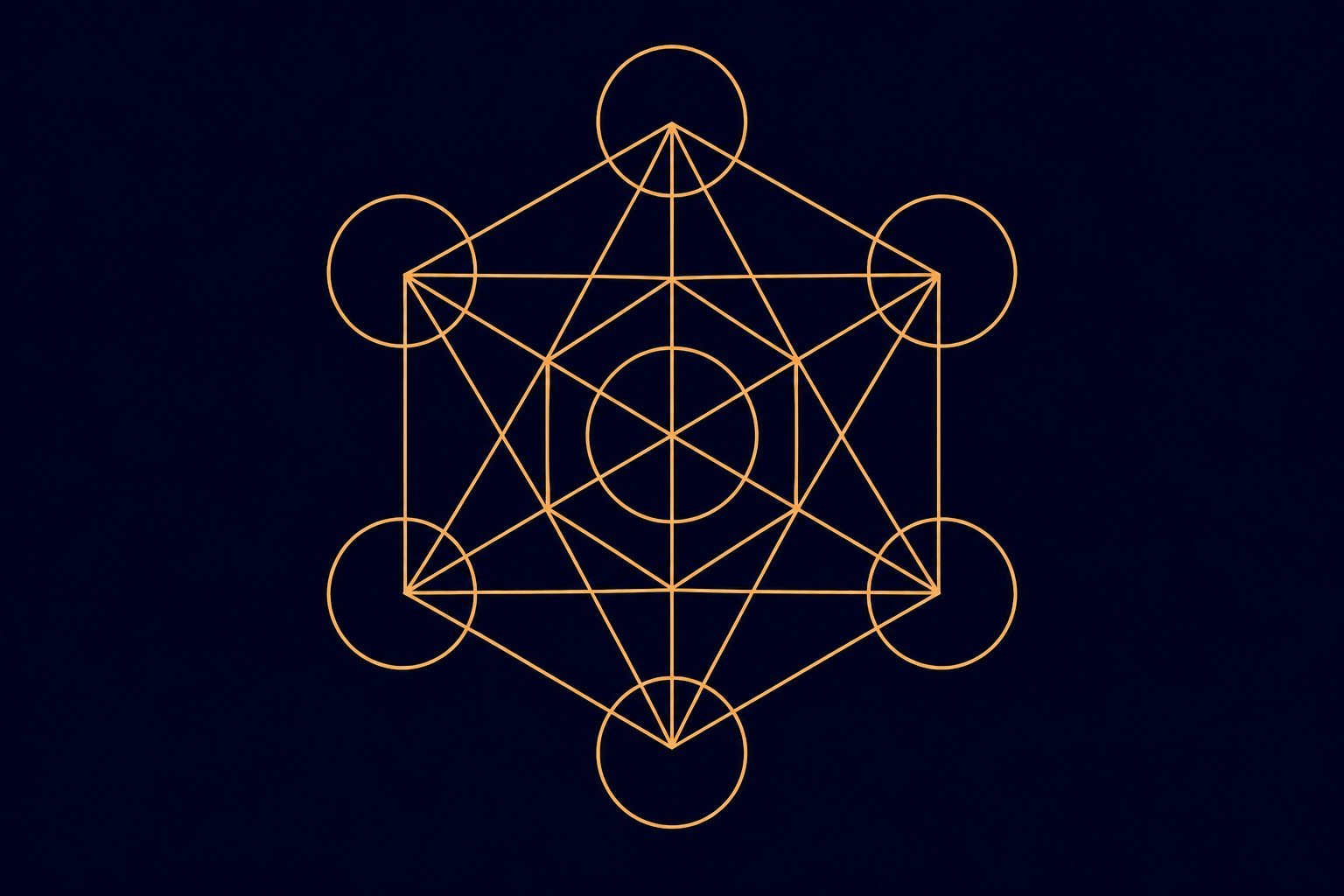
Metatron's Cube
Metatron's Cube
The Geometry of Connection and Perception
The Merkaba carried us into three dimensions. Tetrahedron met tetrahedron. Within their interpenetration, other forms became visible.
Now we return for a moment to the plane — but we return carrying everything we have learned about relationship, structure and depth. Thirteen points are arranged within a field of circles. Connect each centre to every other centre and a dense network appears: Lines cross. Triangles emerge. Hexagonal relationships become visible. Forms seem to advance and recede within the field. Look one way and one structure appears. Shift your attention — and another becomes visible. The diagram itself hasn't changed but we have changed how we are looking.
This is the diagram widely known in contemporary sacred geometry as Metatron's Cube.
This is the geometry of connection and perception: Many points. Many relationships. One underlying field. The points remain fixed. The connections remain. Attention moves. And different relationships within the whole become visible.
The Geometry of Metatron's Cube
The construction commonly begins with thirteen equal circles arranged in a sixfold pattern often called the Fruit of Life in contemporary sacred geometry.
Take the centre point of each of those thirteen circles. Then connect each centre to every other centre with a straight line. Thirteen points produce 78 distinct pairwise connections. The result is the intricate network known as Metatron's Cube.
Despite its name, it's not literally a cube, it's a two-dimensional geometric diagram. And something fascinating happens within it. The complete network contains so many overlapping relationships that selected lines can be emphasised while others recede. A tetrahedral projection may become apparent. Then a cube. Then an octahedral form. Other polyhedral relationships can be explored through different selections and projections.
Nothing has been added to the underlying field. Nothing has been removed. What becomes visible depends partly upon which relationships we choose to follow.
The Platonic Solids Within the Cube
Contemporary sacred-geometry literature frequently states that Metatron's Cube contains all five Platonic Solids. This statement requires care. The Tetrahedron, Cube and Octahedron can be represented particularly naturally through selections within the diagram's geometric network.
Representations associated with the Icosahedron and Dodecahedron are also commonly drawn in connection with Metatron's Cube, but these involve choices of projection and construction and should not be understood as five perfect three-dimensional solids literally concealed inside a flat diagram.
The distinction matters.
And yet the more modest mathematical observation is already remarkable; one network can support multiple geometric readings. We need not exaggerate what is present in order to appreciate what is there.
Metatron and the Cube
Here history and contemporary sacred geometry need to be gently separated.
Metatron is an important angelic figure within Jewish mystical literature, appearing prominently in texts associated with the Hekhalot and Merkavah traditions, including 3 Enoch. But the ancient mystical figure Metatron and the diagram now called Metatron's Cube should not automatically be treated as a single historical tradition. There is no secure historical evidence that this particular thirteen-point construction was known in early Jewish mysticism as Metatron's Cube, or that ancient Jewish mystical texts describe Metatron possessing, transmitting or working through this diagram.
The association appears to belong to much more recent sacred-geometric and esoteric traditions. This does not prevent contemporary practitioners from finding meaning in the association. It simply allows each tradition to retain its own history. The ancient figure and the modern diagram need not be made historically identical in order for either to remain meaningful.
A Master Teacher of Perception
And now we arrive at something the diagram can teach us simply through the experience of looking.
At first, Metatron's Cube can appear almost overwhelmingly complex. Too many lines. Too many intersections. Too much information arriving simultaneously.
But stay with it.
Allow your attention to settle upon one relationship. A triangle appears. Follow another group of lines.
A hexagon emerges. Shift again. Something resembling a three-dimensional structure begins to move forward from the plane.
The geometry was available before we noticed it.
Sometimes something becomes visible not because it has suddenly appeared, but because we have learned how to see it. In this sense, Metatron's Cube can become a Master Teacher of perception. It demonstrates something deceptively simple; attention changes experience.
The field remains the same. The relationships remain available, but where we place our attention influences what becomes prominent and what recedes. This does not mean that every interpretation we perceive is equally true, quite the opposite. Metatron's Cube teaches a second lesson at precisely the same time. Perception requires discernment.
Human beings are extraordinarily gifted pattern-makers: We recognise relationships. We organise complexity. We discover structures that were previously unseen, but we can also perceive patterns that are incomplete, coincidental, or simply not there.
So the invitation is not merely: Look differently. It is also: Look carefully.
Openness and discernment need not oppose one another. Perhaps mature perception requires both Perspective and the Whole.
There is another layer. Choose one part of Metatron's Cube and it may dominate your awareness. Choose another and the first seems to disappear. Yet neither necessarily ceased to be present and this offers a powerful metaphor for human experience.
We encounter life from a position. A history, a culture, a body, a moment in time or a particular state of awareness. From there, some relationships are obvious. Others may be almost impossible to see. Another person, standing metaphorically elsewhere within the same field, may notice something we cannot.
This doesn't mean that every perspective is equally accurate. Nor does it mean that contradictory claims automatically become compatible: Truth still matters. Evidence matters. Discernment matters.
But Metatron's Cube invites another question alongside them: Can something be visible from one perspective without that perspective revealing the whole? One view may be genuine — and yet still incomplete.
Sometimes wisdom may involve learning to move our attention without immediately abandoning what we previously saw. To hold one face, then another, and gradually become capable of imagining the larger form.
Within The Geometry of Souls
Here, Metatron's Cube becomes a meditation upon relationship, attention and perception. The points alone are simple. Connections generate complexity. And perception begins organising that complexity into meaning.
This returns us to one of the oldest movements in our journey.
The Point said: I AM. The Cross said: I AM HERE. The Merkaba invited: I inhabit HERE. And now Metatron's Cube adds: I AM IN RELATIONSHIP.
To be here is to participate in a field of relationships: With people. With place. With Earth. With memory. With circumstance. With everything that has helped shape the particular position from which we currently see. No single line explains the whole, no single point contains the complete diagram, and no single perspective reveals every relationship available within it.
Perhaps consciousness develops partly by learning to see more of the field. Not necessarily by rejecting what we once perceived — but by discovering what else is present: A relationship previously invisible. A connection overlooked. A pattern misunderstood. A viewpoint we had never considered. Nothing outside us necessarily changed. We changed how we looked. And sometimes that is enough for an entirely different possibility to become visible.
The Sacred Practice of Discernment
This is where Metatron's Cube becomes especially important within The Geometry of Souls. A sacred path need not require unquestioning belief. Wonder does not ask us to surrender discernment. Mystery does not require certainty.
We can encounter an extraordinary correspondence and say: How beautiful. Then ask: Is it true? We can encounter an ancient claim and ask: How old is it really? We can experience something personally profound and say: This was real for me without insisting - therefore everyone must understand reality as I do.
That distinction does not diminish the sacred. It creates room around it: Room for inquiry. Room for different perspectives. Room for mystery. Room for discovery. And perhaps this is one of Metatron's Cube's most valuable metaphors; learning to see more does not require pretending that everything we see is true. The open mind and the discerning mind can be the same mind.
How to Work With Metatron's Cube
Begin with one point.
Do not attempt to comprehend the whole diagram.
Simply look.
Follow one line from that point to another.
Then another.
Allow a small relationship to become visible.
Gradually soften your gaze and become aware of the larger field.
Notice what your eye selects.
Notice which shapes advance.
Notice which lines recede.
Then deliberately change your focus.
Can you see something else without destroying what you saw before?
Ask quietly:
What becomes visible when I change where I place my attention?
Then:
What might I be unable to see from where I currently stand?
And finally:
Am I seeing what is there — or what I expect to see?
There is no need to solve the diagram.
The practice is the looking.
The shifting.
The questioning.
The discernment.
And perhaps, occasionally — the seeing anew.
And the more relaxed you allow yourself to be, the more your eyes and mind will perceive.
This is the geometry of connection and perception.
This is Love —
as consciousness learning that a larger field may become visible when we learn to look again.
Continue on to the Fundamentals of The Platonic Solids
Click on the image below...