The Fundamentals
of Sacred Geometry
The Platonic Solids
Why There Are Only Five 3-Dimensional Platonic Solids
Before meeting the five Platonic Solids individually, it helps to understand something extraordinary about them. There are not five because mathematicians chose five particularly beautiful forms from among many possibilities. Under the defining rules of the Platonic Solids, five is all that three-dimensional Euclidean space allows.
A Platonic Solid must satisfy three conditions:
1. Every face is the same regular polygon.
2. All faces are congruent equilateral triangles, squares, or regular pentagons. Different polygon types are never mixed within a Platonic Solid.
3. The same number of faces meet in the same way at every vertex.
Every corner therefore has an identical geometric arrangement. The solid is convex. The form has no indentations or inward-folding regions. These deceptively simple conditions lead to a remarkable mathematical limit.
The Rule at the Vertex
To create a three-dimensional corner, the interior angles of the faces meeting at a vertex must add to less than 360°. If they add to exactly 360°, the polygons lie flat around the point. If they exceed 360°, they can't fold together in the required convex arrangement. And because at least three faces are needed to form a vertex, the possibilities become surprisingly limited.
With equilateral triangles, each interior angle is 60°:
3 triangles: 3 × 60° = 180° → Tetrahedron
4 triangles: 4 × 60° = 240° → Octahedron
5 triangles: 5 × 60° = 300° → Icosahedron
But:
6 triangles: 6 × 60° = 360° → flat. So the triangular family ends there.
With squares, each interior angle is 90°: 3 squares: 3 × 90° = 270° → Cube
But: 4 squares: 4 × 90° = 360° → flat.
So there can be only one Platonic Solid made from squares.
With regular pentagons, each interior angle is 108°:
3 pentagons: 3 × 10⁸° = 324° → Dodecahedron
But four already give:
4 × 10⁸° = 432°
Too much. And with regular hexagons, the possibilities disappear entirely.
Each interior angle is 120°, so even the minimum of three gives:
3 × 120° = 360° - Flat.
Every regular polygon with more than six sides has an even larger interior angle, so none can satisfy the requirement either. And there the door closes.
Three possibilities from triangles.
One from squares.
One from pentagons.
Exactly five.
The Five
The complete family is therefore:
Tetrahedron — 4 triangular faces
Cube — 6 square faces
Octahedron — 8 triangular faces
Icosahedron — 20 triangular faces
Dodecahedron — 12 pentagonal faces
There is no sixth convex regular polyhedron waiting to be discovered. The classification is complete.
Euler's Beautiful Confirmation
All five Platonic Solids also satisfy one of the great relationships of polyhedral geometry:
V − E + F = 2
where:
V = vertices
E = edges
F = faces
This is Euler's polyhedron formula.
For the Cube, for example:
8 vertices − 12 edges + 6 faces = 2.
For the Tetrahedron:
4 − 6 + 4 = 2.
And the relationship continues through all five.
Euler's formula is not, by itself, the reason there can be only five Platonic Solids; it applies much more broadly to convex polyhedra. But together with the strict regularity conditions of the Platonic Solids, it belongs to the deeper mathematical framework describing these remarkable forms.
Within The Geometry of Souls
And here mathematics gives us something we don't need to embellish. There really are only five. Not because five was declared sacred and geometry was subsequently arranged to accommodate the belief, or because humans selected five forms and excluded the others, but because once the conditions are established, the mathematics itself imposes a limit.
Geometry permits:
four faces,
six faces,
eight faces,
twelve faces,
twenty faces.
And no other convex regular polyhedron.
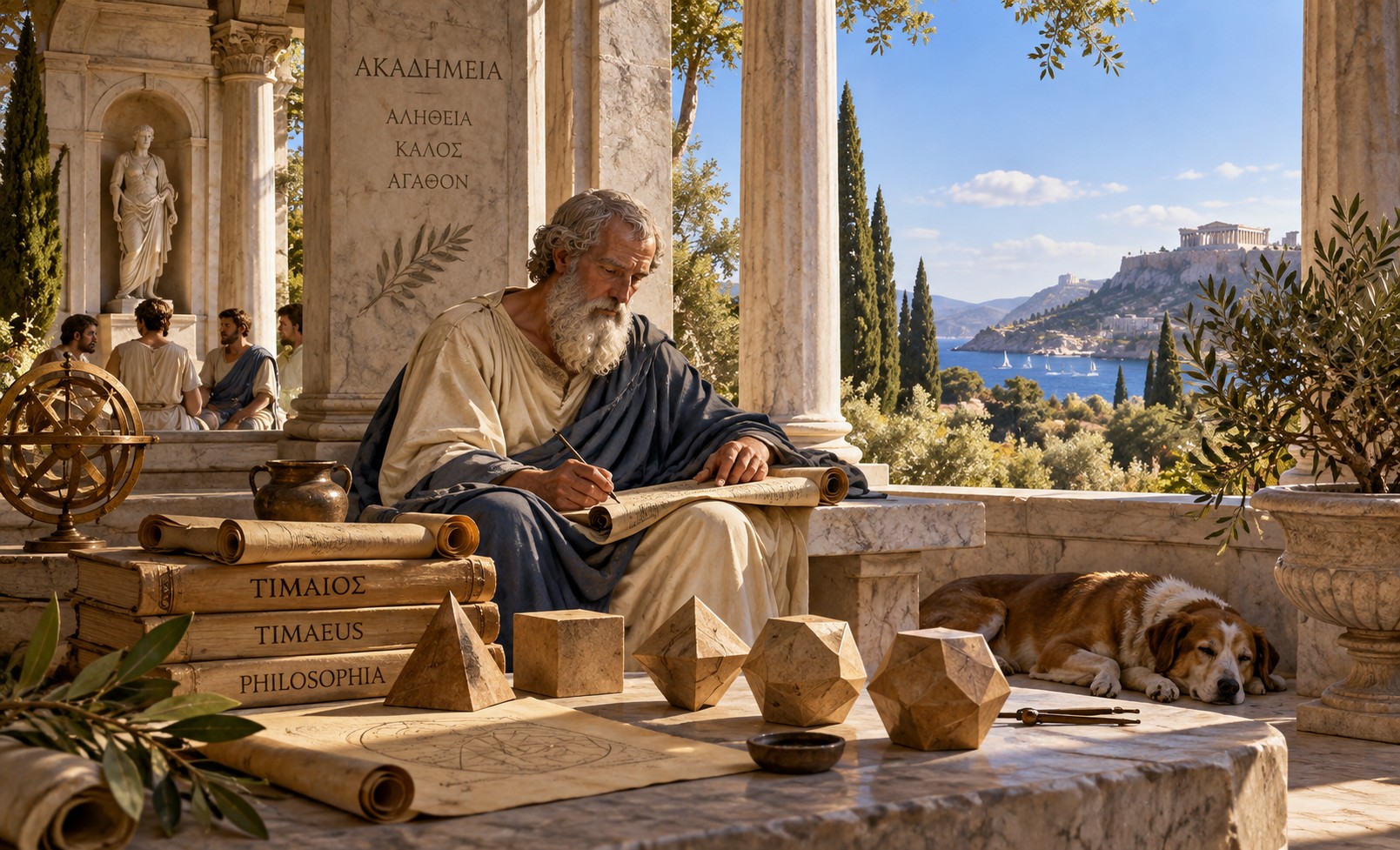
Ancient Greek mathematicians studied these regular solids, and Plato gave them an enduring cosmological interpretation in the Timaeus, associating four with the classical elements and the fifth with the cosmos. Those meanings belong to the history of philosophy. The fact that there are exactly five belongs to mathematics. And the clear division makes both stories stronger.
Within The Geometry of Souls, the Platonic Solids therefore become a meditation upon possibility within constraint. Not everything that can be imagined can exist under every set of conditions, and rules do not always diminish creativity. Sometimes rules are precisely what allow form to emerge. And sometimes, when every possibility has been explored, mathematics arrives at a boundary and quietly says; these are the forms that remain.
Five. No more. No less.
This is the geometry of perfect regularity. This is Love — as infinite possibility discovering the beauty of form through limitation.

The Tetradhedron
The Tetrahedron
The First Enclosure
We have established the rules. Five forms — and only five — can satisfy them and now we meet the simplest of the family: the Tetrahedron. Four equilateral triangular faces. Four vertices. Six equal edges. Three faces meet at every vertex. It is the Platonic Solid with the fewest faces, edges and vertices.
And yet with this extraordinary economy, something fundamental happens; space becomes enclosed.
This is the geometry of first structure: Four points. Four faces. One enclosed volume. The triangle acquires depth. The plane becomes spatial. And with the smallest possible number of faces, a three-dimensional world is formed.
The Geometry of the Tetrahedron
The word tetrahedron means, quite literally, four faces. In the regular tetrahedron, every face is an equilateral triangle and every edge has the same length. Three triangular faces meet at each vertex. Because three points can define a triangular face but cannot enclose a three-dimensional volume, a fourth point is required outside that plane. Connect it to the first three — and the Tetrahedron appears. This makes the tetrahedron the simplest possible polyhedron.
There is another beautiful property. Among the five Platonic Solids, the Tetrahedron stands alone as self-dual. In geometric duality, the faces of one polyhedron correspond to the vertices of another. The Cube and Octahedron form a dual pair. The Icosahedron and Dodecahedron form another. But the dual of a Tetrahedron is another Tetrahedron. Four faces. Four vertices. The relationship turns inside out — and returns to itself.
Plato and Fire
In Plato's Timaeus, the Tetrahedron was associated with fire. This was not merely because Plato thought the shape looked fiery. His cosmology proposed that four kinds of matter were constructed from regular geometrical bodies: the Tetrahedron with fire, Octahedron with air, Icosahedron with water, and Cube with earth. The Dodecahedron was given a different cosmological role associated with the universe as a whole.
Plato connected the Tetrahedron's small size, sharp vertices and acute geometry with the penetrating and mobile qualities he attributed to fire. This belongs to ancient Greek natural philosophy. It's not a modern scientific description of fire. Fire is not literally composed of microscopic tetrahedra. But Plato's proposition remains historically extraordinary - matter understood through geometry.
More than two thousand years before modern atomic physics, he was asking whether the different qualities of the physical world might somehow be related to underlying mathematical structure. His answer was not our scientific answer. But the question itself still resonates.
Where We Encounter Its Echo
Tetrahedral geometry genuinely appears throughout modern science. One of its most familiar examples occurs in chemistry. A carbon atom bonded to four other atoms often exhibits approximately tetrahedral molecular geometry — methane, CH₄, being the classic example. The tetrahedron also appears in crystal structures, molecular arrangements, structural engineering and geometric optimisation.
However, a tetrahedral molecule is not evidence that Plato's element of fire was scientifically correct. Nor does every tetrahedral structure in nature carry sacred meaning. Rather, the Tetrahedron is one of the geometries available to physical systems — and under particular conditions, nature uses it. The geometry is extraordinary unto itself.
Within The Geometry of Souls
Here, the Tetrahedron becomes a meditation upon the first act of embodiment through limitation. Infinite possibility is not yet a particular experience. For something specific to arise, conditions must appear: Boundaries. Relationships. Constraints.
The Tetrahedron demonstrates this with exquisite simplicity. A plane alone does not enclose volume, but add another dimension, establish four vertices, connect them according to particular relationships, and suddenly there is - "within". Something has been enclosed and has become inhabitable.
Within The Geometry of Souls, we might contemplate incarnation in much the same way. Not as a claim derived from mathematics, but as a philosophical proposition: What if limitation is not merely the opposite of freedom? What if limitation is one of the conditions through which a particular experience becomes possible? A limitless being cannot experience this particular place without somehow entering location and boundless possibility can't become this particular life without accepting conditions.
Here. Now. This body. This world. This moment.
The boundaries that appear to restrict experience may also be what make a particular experience possible at all, and suddenly our earlier phrase acquires another dimension: infinite possibility discovering the beauty of form through limitation.
The Tetrahedron is our first perfect demonstration. Limitation, not as punishment, or failure, but as the architecture through which experience becomes particular. The infinite enters form — and discovers what can only be experienced from within. This is the geometry of first structure. This is Divine Love — as possibility entering limitation in order to become experience.
How to Work With the Tetrahedron
Begin with a triangle.
Three points.
One plane.
Now imagine a fourth point rising away from that plane.
Connect it to each of the original three.
Notice what has happened.
The flat figure has become spatial. An inside has appeared.
Allow yourself to contemplate the Tetrahedron not as confinement,
but as enclosure capable of holding experience.
Then ask quietly:
What limitations in my life have given shape to who I have become?
Not every limitation is beneficial.
Some should be challenged.
Some should be removed.
Some are unjust and should never be spiritualised into necessity.
But others may be the very conditions through which something became possible.
A commitment.
A body.
A place.
A relationship.
A lifetime.
You might then ask:
What has become possible because I could not be everywhere, everything, all at once?
Remain with the form.
Four faces. Four vertices. Six edges.
The simplest enclosure.
Notice what arises.
The Cube
The Cube
The Geometry of Foundation
The Tetrahedron gave us the first enclosure. Possibility entered limitation. An inside appeared.
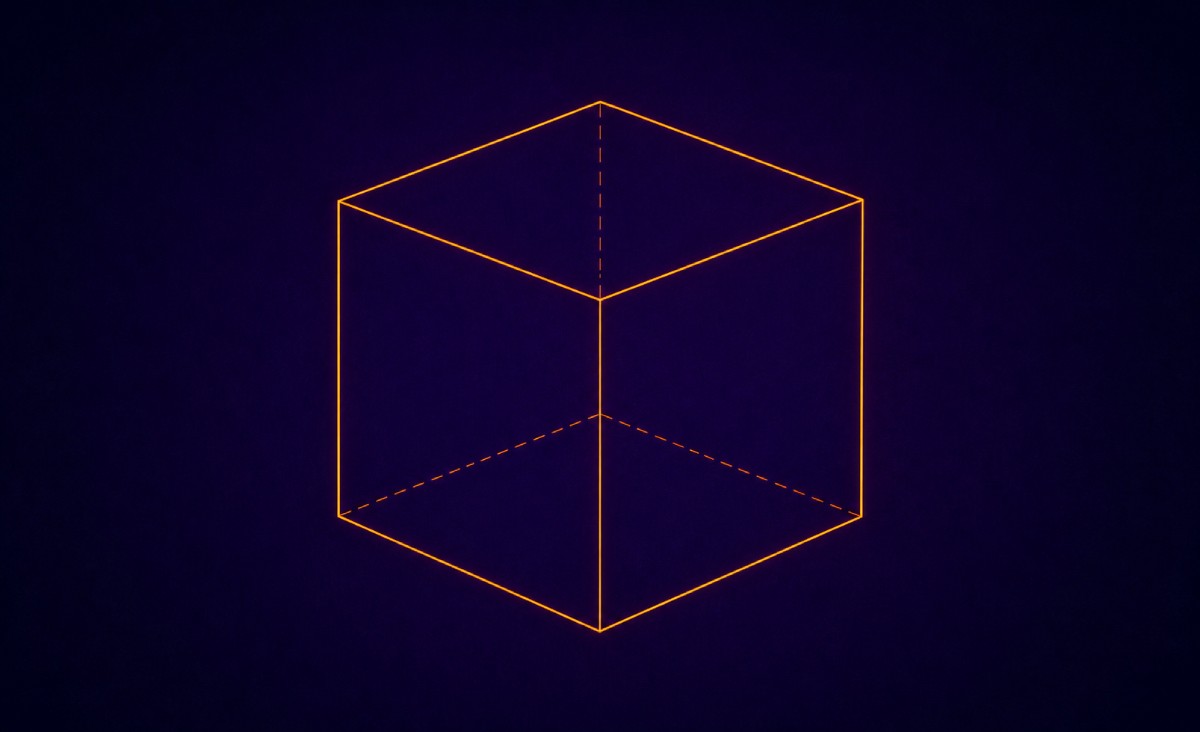
Now the geometry changes. The triangular face becomes square. Four equal sides. Four right angles. Six identical faces close around a volume. And a form of remarkable stability appears: the Cube.
This is the geometry of foundation: Six equal faces. Twelve equal edges. Eight vertices. Three faces meeting at every corner. Parallel planes. Perpendicular directions. A form that establishes length, width and height with extraordinary clarity.
The Tetrahedron enclosed space with the minimum possible structure. The Cube seems to organise it.
The Geometry of the Cube
The Cube is the only Platonic Solid made from squares. Every one of its six faces is congruent. Every edge has the same length, every face meets its neighbours at right angles, and opposite faces are parallel. Its symmetry allows it to look different as it turns while remaining geometrically unchanged. And unlike the other Platonic Solids, the Cube can fill three-dimensional Euclidean space completely using identical copies of itself.
Cube beside cube. Above cube. Below cube. No gaps. No overlaps. Space can be divided into an endless regular lattice of equal cubic cells. The Cube therefore does something particularly significant: it measures space while simultaneously occupying it.
The Cube and the Octahedron
The Cube also introduces us to one of the most elegant relationships among the Platonic Solids - duality.
Place a point at the centre of each of the Cube's six faces. Connect those neighbouring points. An Octahedron appears.
Reverse the process—place points at the centres of an Octahedron's eight faces—and those points form the vertices of a Cube.
Six faces become six vertices. Eight vertices become eight faces. The twelve edges remain twelve. Cube and Octahedron are geometric partners. Neither is the other, yet each contains the structural relationship through which the other can be revealed.
We'll meet the Octahedron next.
Plato and Earth
In Plato's Timaeus, the Cube was associated with earth. Plato imagined the four elemental kinds as constructed from regular geometric bodies: fire from tetrahedra, air from octahedra, water from icosahedra, and earth from cubes. The Cube's stability made it particularly appropriate, within Plato's cosmology, for earth.
Unlike the three elemental solids constructed from triangular faces of one type, Plato's Cube was built from square faces ultimately composed of isosceles right triangles. This difference meant that, within his model, earth did not transform into the other three elemental kinds in the same way that fire, air and water could transform among themselves. This is ancient Greek natural philosophy—not modern chemistry or physics. Earth is not literally made from microscopic cubes. But Plato was doing something intellectually remarkable: he was asking whether the qualities of matter might arise from underlying geometric structure.
His particular physical theory did not survive. The larger question did.
Where We Encounter Its Echo
Cubic and closely related structures genuinely occur in the physical world. Crystallography gives us striking examples: some crystalline materials organise themselves with cubic symmetry at the atomic scale. The Cube is also fundamental to human construction and measurement: Rooms. Blocks. Bricks. Grids. Coordinates. Containers. Architectural volumes.
Our built environment repeatedly returns to orthogonal geometry because right angles, parallel planes and repeating units allow space to be divided, measured, stacked and organised efficiently. But once again, resemblance does not require universal symbolism. A cubic crystal is not expressing Plato's element of Earth, or a cubic building is not inherently sacred. The geometry simply possesses properties that make it remarkably effective at holding, dividing and organising space.
Within The Geometry of Souls
Here, the Cube becomes a meditation upon grounding and inhabitation.
The Tetrahedron asked: What becomes possible through limitation?
The Cube asks another question: Once form exists, can you inhabit it? There is a difference between entering embodiment and becoming fully present within it. Within The Geometry of Souls, the Cube may therefore represent the willingness to be here: Within the body upon the Earth, within time, within circumstance, and within the particular dimensions of this particular life.
Its six faces create boundary, but those boundaries also create a room, an interior, a place that can be occupied. And perhaps this is another lesson of limitation. Boundary does not only exclude. Boundary can hold.
The walls of a vessel allow it to contain. The banks of a river give water direction. The boundaries of a musical measure allow rhythm to take form. The edges of the Cube allow space to become inhabitable.
And so the Cube offers an important counterpoint to our earlier encounter with Infinity.
Infinity opened the boundary. The Cube establishes one. Neither need invalidate the other. Perhaps the limitless and the limited belong to different dimensions of the same experience.
Within The Geometry of Souls, incarnation might therefore be contemplated not merely as entering limitation — but as learning to inhabit limitation consciously: To stand upon the Earth without forgetting the Infinite. To occupy a body without believing the body exhausts the mystery of what we are. To accept: Here is where I am. And then to ask: What can Love build from here?
This is the geometry of foundation.
This is Divine Love — as possibility becoming grounded enough to inhabit its own creation.
How to Work With the Cube
Imagine a simple Cube around you.
Not as a prison.
Not as a protective force field.
Simply as geometry.
Above.
Below.
Before.
Behind.
Left.
Right.
And you — at the centre.
Notice how immediately the form establishes orientation.
Then bring your attention downward.
To your body.
To the surface beneath you.
To the physical place in which you actually are.
Ask quietly:
Am I fully here?
Then:
What in my life needs a stronger foundation?
And perhaps:
What boundary would help something precious take form?
Do not assume that every boundary is restrictive.
Nor that every boundary is healthy.
Simply contemplate the relationship between freedom and structure.
What needs opening?
What needs containing?
What needs somewhere solid upon which to stand?
Remain within the Cube for a few moments.
Notice what arises.
The Octahedron
The Octahedron
The Geometry of Balance
The Cube gave us foundation. Six square faces enclosed space with clarity and stability. Now take the centre of each of those six faces and connect those centres: A new form emerges from within the Cube -
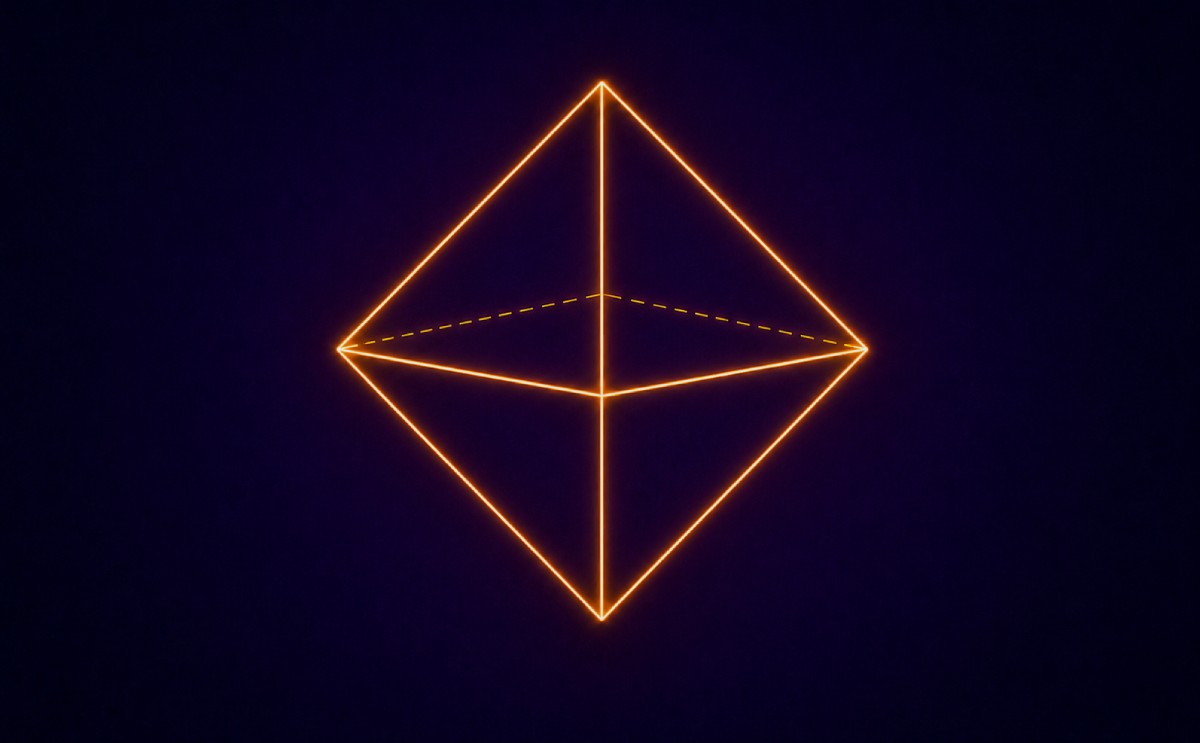
the Octahedron. Eight equilateral triangular faces. Twelve equal edges. Six vertices. Four faces meeting at every vertex. Two square pyramids appear to meet perfectly at their bases — one rising, one descending.
This is the geometry of balance. Above and below. Expansion and contraction. Two directions held around a shared centre. The Cube grounded us. The Octahedron brings us back into equilibrium.
The Geometry of the Octahedron
The regular Octahedron is one of the five Platonic Solids. Its name means eight faces. Each of those faces is an equilateral triangle.
It has: 8 faces, 12 edges, 6 vertices, and four triangular faces meet at every vertex.
Its symmetry is particularly beautiful. Imagine a square lying horizontally through its centre. From each of the square's four corners, edges rise to a single vertex above and descend to another vertex below. The result can be visualised as two identical square pyramids joined base to base. But the joining square is not an additional face. It lies inside the solid. What we see externally is one continuous structure of eight triangles.
Cube and Octahedron: The Geometry of Duality
We have already encountered this relationship from the Cube's perspective. Now we can look back. Place a point at the centre of each of the Octahedron's eight triangular faces and connect neighbouring points. A Cube appears.
The transformation works in both directions. Cube → Octahedron - Octahedron → Cube
Faces become vertices. Vertices become faces. And remarkably, both retain the same number of edges:
twelve. This is geometric duality. Neither solid contains the other as a tiny physical object. Rather, the structural relationships of one generate the other. And so Earth, in Plato's symbolism, has as its mathematical dual the form he associated with Air. That elemental correspondence is philosophical rather than mathematical. But the duality itself is exact.
Plato and Air
In Plato's Timaeus, the Octahedron was associated with air. Plato related the relative characteristics of the elemental solids to the qualities he perceived in the elements themselves. The Tetrahedron, smallest and sharpest, became fire. The Cube became earth. The Icosahedron, coming up next, with its many faces and greater mobility, became water. Between them stood the Octahedron: Air.
Again, this belongs to ancient Greek natural philosophy rather than modern physical science. Air is not composed of microscopic Octahedra. But Plato's larger inquiry remains fascinating. Could qualities we experience in the material world somehow arise from underlying structure? Modern science answers that question very differently. Yet once again, the ancient intuition that structure matters was far from trivial.
Where We Encounter Its Echo
Octahedral geometry appears genuinely within nature and science. In crystallography, the mineral fluorite can form octahedral crystals, and several other minerals may express octahedral forms through crystal growth or cleavage.
In chemistry, octahedral molecular geometry describes arrangements in which six atoms, ions or groups surround a central atom symmetrically along three perpendicular axes. So the Octahedron is not merely an abstract mathematical invention. Under particular physical conditions, matter can organise itself according to octahedral relationships. That does not make those structures inherently sacred. But it gives us something perhaps more valuable - geometry and matter genuinely meet.
Within The Geometry of Souls
Here, the Octahedron becomes a meditation upon balance around a centre. Look at the form. One vertex rises. One descends. Four extend around the middle. Everything is organised around a point we cannot see from the exterior — the centre.
And suddenly we encounter an old friend again. The Point. But the Point has changed once more.
It began as: I AM.
At the Cross: I AM HERE.
Within the Merkaba: I inhabit HERE.
And now the Octahedron asks: Can I remain centred while moving between directions?
This is not balance understood as perfect stillness. Living balance is rarely static. A bird adjusts constantly while flying. A human body makes countless tiny corrections simply to stand upright. An ecosystem responds continually to changing conditions. Balance is not necessarily the absence of movement. Often it's the continuous intelligence of adjustment, and that distinction matters because we sometimes imagine spiritual balance as reaching a state in which nothing disturbs us.
Perhaps that isn't balance at all. Perhaps balance is the capacity to move — and return. To expand — and return. To encounter difficulty — and return. To love — and return. Not endlessly retreating into the centre, but learning to remain related to it while fully participating in life.
Air and the Space Between
Within the contemplative language of The Geometry of Souls, Plato's association with Air offers another possibility. Air is difficult to see. Yet we live within it. We breathe it. It moves between us. It enters the body and leaves again.
The breath is an extraordinary threshold: something outside becomes inside. Something inside returns outside. Again and again. The boundary remains — yet exchange continues across it.
The Cube taught us: Boundary can hold. The Octahedron adds: Boundary can also breathe.
We don't have to choose between integrity and openness. A healthy boundary does not necessarily seal us away from relationship. It may allow exchange while preserving form. And perhaps that is another expression of balance: remaining oneself while allowing life to move through.
The Hidden Octahedron
There is one more beautiful return. We have already encountered this form. Inside the interpenetrating tetrahedra of the Merkaba, their shared central region forms an Octahedron. It was there all along, hidden inside another geometry, and now we meet it directly.
And that echoes something Metatron's Cube has already taught us: sometimes a form becomes visible not because it has suddenly appeared, but because we have learned how to see it. Within The Geometry of Souls, that may be one of the great lessons of perception. Growth does not always give us something new. Sometimes growth reveals what was already present.
This is the geometry of balance. This is Divine Love — as movement learning to remain in relationship with centre.
How to Work With the Octahedron
Bring your attention first to its centre.
Imagine the upper vertex.
Then the lower.
Notice the vertical relationship between them.
Now become aware of the four vertices extending around the middle.
Six directions.
One centre.
If it feels natural, allow your breathing to accompany the geometry.
Inhale.
Expand.
Exhale.
Return.
There is no need to force a rhythm or visualise energy.
Simply notice movement around stillness.
Ask quietly:
What does balance mean for me now?
Then perhaps:
Where have I mistaken balance for remaining unchanged?
And finally:
Can I move without losing my centre?
Remain with the form.
Let the breath move.
Notice what arises.
The Icosahedron
The Icosahedron
The Geometry of Flow
The Octahedron brought us into balance. Movement could occur without losing relationship with centre.
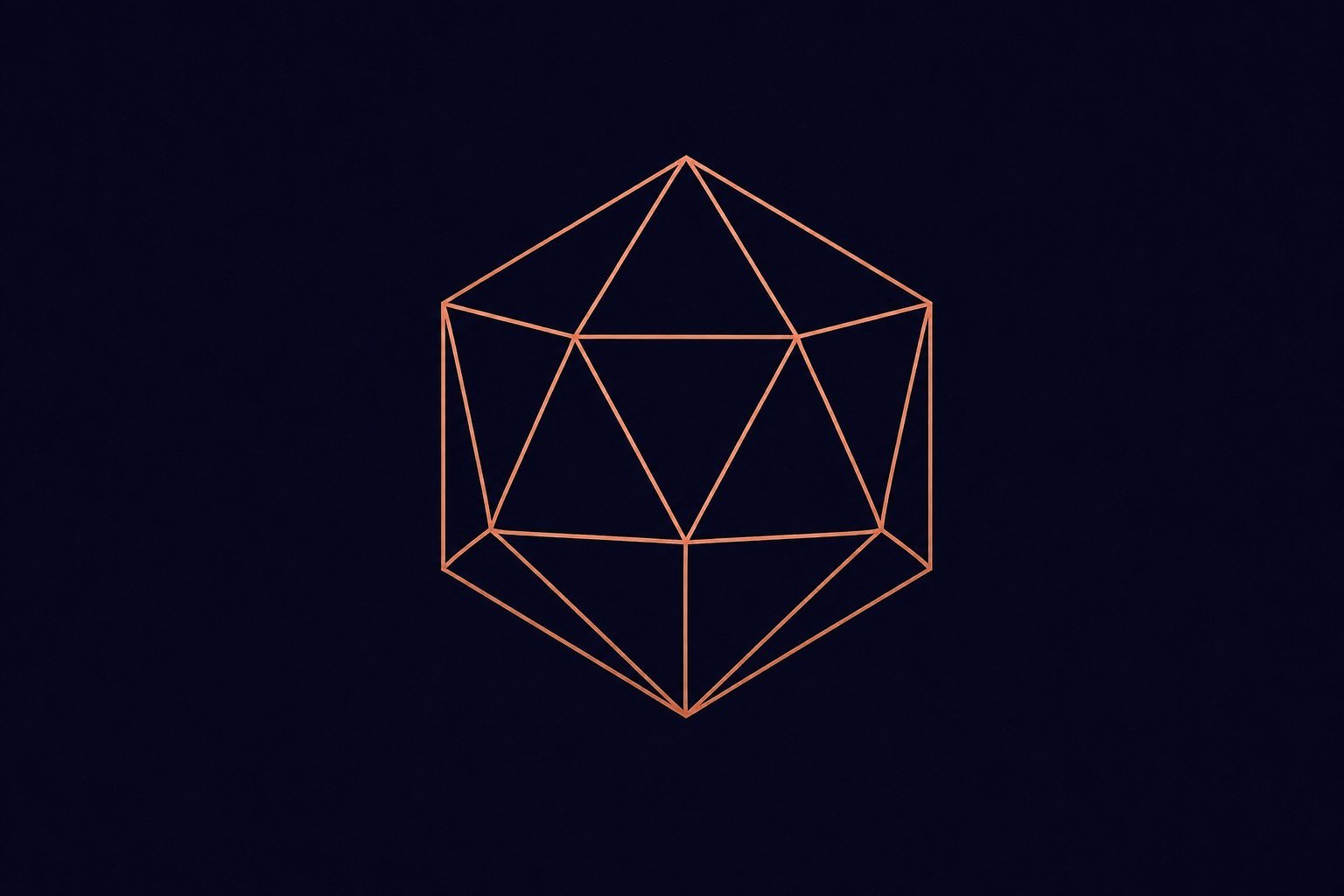
Now the number of faces increases. Eight becomes twenty. The angular form begins to soften. The solid becomes increasingly sphere-like. And geometry seems to acquire another quality: flow. Twenty equilateral triangular faces. Thirty equal edges. Twelve vertices. Five triangles meeting at every vertex.
This is the Icosahedron.
This is the geometry of flow: Many faces. Many directions. One coherent form. Structure remains —but rigidity seems to lessen. The geometry does not lose its boundaries. It learns to move through them.
The Geometry of the Icosahedron
The word icosahedron means twenty faces. In the regular Icosahedron, every one of those twenty faces is an equilateral triangle. It has: 20 faces, 30 edges, 12 vertices. Five triangular faces meet at every vertex.
Remember our rule from the beginning - each equilateral triangle contributes an angle of 60°. Five meet at each vertex: 5 × 60° = 300° - still less than 360°. So the faces can fold inward and close. But only just one step further would destroy the possibility: six triangles would produce exactly 360° and lie flat. The Icosahedron therefore takes the triangular face as far as the Platonic rules permit.
Tetrahedron: three triangles at each vertex.
Octahedron: four.
Icosahedron: five.
And then — no further.
Once again, limitation determines form.
Approaching the Sphere
Something visually remarkable happens as the number of faces increases. Compare the Tetrahedron with the Icosahedron. Both are constructed entirely from equilateral triangles. Yet their characters seem completely different. The Tetrahedron is unmistakably angular. The Icosahedron begins to suggest roundness. It remains a polyhedron — twenty perfectly flat faces meeting along straight edges — but its twelve vertices are distributed with great symmetry around its centre.
Place those vertices upon a circumscribed sphere and every one touches that same sphere. The solid begins to approximate curvature through multiplicity. This is important to notice: the Icosahedron is not a sphere, but it shows how repeated flat surfaces can collectively approach something that appears increasingly curved. Many small planes can create one 'nearly spherical' whole.
Icosahedron and Dodecahedron
Now another duality appears. Place a point at the centre of each of the Icosahedron's twenty triangular faces and connect neighbouring points. Those twenty points become the vertices of a Dodecahedron.
And reverse the process. Place a point at the centre of each of the Dodecahedron's twelve pentagonal faces and those twelve points become the vertices of an Icosahedron.
Look at the exchange: Icosahedron: 20 faces, 12 vertices. Dodecahedron: 12 faces, 20 vertices. Both have thirty edges. Faces and vertices exchange roles. The relationship is exact. So just as the Cube quietly carried the Octahedron within its geometric relationships, the Icosahedron points ahead to our final Platonic Solid.
Water already carries a doorway towards the Cosmos. Not as scientific fact, nor as metaphysical proof, but as a beautiful relationship within the geometry itself.
Plato and Water
In Plato's Timaeus, the Icosahedron was associated with water. The assignment belonged to Plato's attempt to explain differences between the elemental kinds through their underlying geometrical structures. The Icosahedron's many faces made it, within that model, comparatively mobile and smooth — qualities Plato associated with water. Again, this is ancient Greek natural philosophy. Water molecules are not microscopic Icosahedra but the philosophical intuition is fascinating: different structures may produce different behaviours.
And once more, modern science would eventually answer that question in profoundly different ways while retaining the underlying insight that the arrangement and structure of matter, matter enormously.
Where We Encounter Its Echo
And here the Icosahedron gives us a particularly extraordinary meeting between mathematics and biology - viruses.
Many roughly spherical viruses construct their protein shells with icosahedral symmetry. This arrangement allows repeating protein components to form highly symmetrical shells around the viral genetic material. This doesn't mean that every such viral capsid is literally a simple twenty-faced Platonic Icosahedron. Larger viral shells commonly use more complex triangulated, quasi-equivalent arrangements while retaining overall icosahedral symmetry.
And this is where the mathematics becomes wonderfully practical. A biological system has a problem: How can repeated building units create an enclosed shell efficiently? Icosahedral symmetry provides one remarkably successful answer. Again, nature is not drawing a sacred symbol. Nature is solving a structural problem, and geometry appears. How beautiful is that!
Within The Geometry of Souls
Here, the Icosahedron becomes a meditation upon flow without loss of form. And now the journey from the Cube becomes especially interesting. The Cube taught: Boundary can hold. The Octahedron answered: Boundary can breathe.
And now the Icosahedron adds: Boundary can move. Not disappear but move. That distinction feels important. Water doesn't cease to be water because it changes shape. Pour it into a bowl, a river, or a hollow in a stone. It meets the conditions of its environment and responds.
Within our contemplative language, water therefore offers a different kind of mastery. Not domination, but rather, adaptation. The ability to encounter changing conditions without abandoning one's essential nature. Perhaps flexibility is not the opposite of integrity, perhaps genuine integrity sometimes requires us to change shape.
The rigid form says: I must remain exactly as I was.
The flowing form asks: What can I become here without ceasing to be myself?
And suddenly we have arrived at another dimension around the idea of humanity as Masters of LIMITATION evolving into MASTERS of Limitation. The MASTER of Limitation need not merely endure the container. Nor merely breathe within it. Perhaps mastery eventually includes learning how to move creatively in relationship with the conditions that are present.
Not every obstacle must be broken. Some can be moved around. Some can be moved through. Some redirect us towards a path we could not previously see. Water knows something about this. Not because water possesses philosophical wisdom — but because humans have watched it for thousands of years and recognised within its behaviour a powerful metaphor for living.
From Many Faces Towards Wholeness
There is another contemplation hidden in the Icosahedron. Twenty faces yet one solid.
Stand directly before one face and much of the geometry remains invisible. Turn the form — another face appears. Turn again — another. No single face reveals the whole Icosahedron and no face is false merely because another face exists. Here Metatron's Cube whispers back into the conversation. Perspective matters. What we see depends partly upon where we stand.
And perhaps this offers another Master Teacher for perception: Can something be true from one perspective without being the whole truth? One face, another face, and another. Twenty perspectives upon one centre. The work of consciousness may not always be to decide which single face is correct. Sometimes it may be to recognise that there is a larger form.
This is the geometry of flow. This is Divine Love as form learning to change without losing relationship with its centre.
How to Work With the Icosahedron
Imagine the Icosahedron turning slowly.
Do not attempt to hold every face simultaneously.
Allow one face to come forward.
Then another. Then another.
Notice that the form remains whole even though your view continually changes.
Bring to mind something in your life that is changing.
Ask quietly:
What am I trying to keep rigid that may need to move?
Then:
What can change without losing what is essential?
And perhaps:
What might become visible if I look from another face?
If you wish, bring the image of water to mind.
Not as a supernatural correspondence.
Simply as a teacher through metaphor.
Held yet moving.
Responsive yet continuous.
Changing form without ceasing to be itself.
Notice what arises.

The Dodecahedron
The Dodecahedron
The Geometry of The Cosmos
The Icosahedron taught us to move, to change perspective, and to remain whole while encountering the world through many faces. Now we arrive at the final Platonic Solid.
The triangle disappears, the square disappears, and in their place comes the pentagon: Twelve regular pentagonal faces. Thirty equal edges. Twenty vertices. Three pentagons meeting at every vertex. This is the Dodecahedron, and with it, the family of five is complete.
This is the geometry of the whole: Twelve faces. Twenty vertices. Thirty edges. One highly symmetrical form and the final possibility permitted by the rules. There is nowhere further for the convex regular polyhedra to go.
The Geometry of the Dodecahedron
The name dodecahedron means twelve faces. Each of those faces is a regular pentagon. It has: 12 faces, 30 edges, 20 vertices, with three pentagonal faces meeting at every vertex.
Remember our rule: The interior angle of a regular pentagon is 108°. Three meet at a vertex:
3 × 10⁸° = 324°
Less than 360°.
The faces can therefore fold together and enclose space.
Try four:
4 × 10⁸° = 432°
Impossible under the rules of a convex regular polyhedron. So once again, geometry establishes the boundary. There is precisely one Platonic Solid constructed from regular pentagons. The Dodecahedron.
The Pentagon and the Golden Ratio
And now an old relationship returns. Draw the five diagonals inside a regular pentagon and a five-pointed star—the pentagram—appears.
Within that construction, lengths repeatedly divide one another according to the golden ratio. The ratio is not being approximately perceived or symbolically imposed, it's inherent in the geometry of the regular pentagon, and because every face of the Dodecahedron is a regular pentagon, the golden ratio appears naturally throughout its mathematical structure.
This gives us a beautiful return to something we encountered with Fibonacci. There, ratios of successive Fibonacci numbers approached the golden ratio. And here, the golden ratio emerges directly from exact geometry. Different doorway. Same mathematical relationship. Return without repetition.
Icosahedron and Dodecahedron: The Second Dual Pair
The Dodecahedron is the geometric dual of the Icosahedron.
The Icosahedron has: 20 faces and 12 vertices.
The Dodecahedron has: 12 faces and 20 vertices.
Both have: 30 edges.
Place a point at the centre of each of the Dodecahedron's twelve pentagonal faces and connect neighbouring points. An Icosahedron emerges. Do the corresponding operation with the twenty faces of the Icosahedron — and a Dodecahedron appears. Once again: faces become vertices; vertices become faces; relationship remains.
The Platonic family now reveals its complete pattern of duality:
Cube ↔ Octahedron
Icosahedron ↔ Dodecahedron
And standing alone:
Tetrahedron ↔ Tetrahedron
The Tetrahedron is self-dual. The other four meet one another in pairs. Five solids held within three relationships.
Plato and the Cosmos
And here Plato does something different. In the Timaeus, four regular solids are associated with the four elemental bodies:
Tetrahedron — Fire.
Cube — Earth.
Octahedron — Air.
Icosahedron — Water.
But when Plato reaches the fifth construction, he doesn't simply give us a fifth material element. Instead, he writes that the god used the remaining fifth construction “for the whole universe, embroidering figures on it.” The exact interpretation of this enigmatic passage has been debated for centuries. It's often summarised by saying that Plato associated the Dodecahedron with the cosmos or the heavens.
We should be careful not to make his brief statement say more than it does, but the difference is unmistakable. The first four describe the elemental world. The fifth is given to the whole. And after the journey we've just made, there is something wonderfully fitting about that.
The Dodecahedron and the Heavens
There may also be a geometrical reason why the Dodecahedron lent itself so readily to celestial interpretation. Its twelve pentagonal faces suggest a division of a surrounding whole into twelve regions. Later thinkers associated this with the twelvefold division of the zodiac, although we can't really assume that this was Plato's precise intention.
The Dodecahedron also has a much more sphere-like appearance than the Cube or Tetrahedron. It seems to occupy an intriguing threshold: clearly faceted, yet approaching roundness; finite, yet suggestive of a surrounding sphere.
The Cosmos imagined through a bounded form. Once again: infinity encountering structure.
Where We Encounter Its Echo
Dodecahedral geometry appears in mathematics, crystallography, chemistry and other areas of scientific investigation, although perfect regular Dodecahedra are much less commonplace in nature than popular sacred-geometry imagery sometimes suggests.
There is also a fascinating archaeological story. Small hollow objects made from copper alloy, usually possessing twelve pentagonal faces with circular openings, have been found across parts of the former Roman Empire. They are commonly called Roman dodecahedra and more than a hundred are known. Remarkably, we still don't know with certainty what they were for. Suggestions have ranged from measuring instruments and candle holders to ritual objects, knitting devices and astronomical tools. But none of those have been conclusively established and we don't need to fill the unknown with certainty. The objects exist, their purpose remains mysterious, and we may wonder without pretending to know.
Within The Geometry of Souls
And now the five solids stand before us. The Tetrahedron gave us first structure. The Cube gave us foundation. The Octahedron gave us balance. The Icosahedron gave us flow. The Dodecahedron asks us to contemplate the whole - and not a whole in which individuality disappears.
Look at the Dodecahedron. Every face remains a pentagon. Every edge remains an edge. Every vertex remains precisely located. The parts don't cease to exist when the whole appears. Rather, their relationships create the whole.
This takes us all the way back to the beginning of our journey. The Point. The Circle. The Vesica Piscis. The Sacred Third. Again and again geometry has shown us that relationship can generate something that no isolated component possesses alone. And now, at the final Platonic Solid, that principle has become three-dimensional and complete. Twenty vertices. Thirty edges. Twelve faces. One Dodecahedron.
The whole cannot exist without the relationships between its parts. Yet no individual part, by itself, is the whole. Perhaps this is one way we might contemplate Cosmos. Not as sameness, or the erasure of difference, but as; unity capable of containing multiplicity.
From Limitation Back Towards Infinity
And now something extraordinary has happened to the theme that began this Platonic journey. We entered these solids through limitation. Strict rules and strict conditions, with only certain possibilities permitted.
Geometry said: Five. No more. Yet those limitations did not impoverish what emerged. They gave us five forms of astonishing beauty, and the final form points symbolically back towards the Cosmos.
So perhaps limitation and infinity were never simply opposites. Form is one way the limitless becomes encounterable: A note limits vibration to a particular frequency — and music becomes possible. A word limits thought into language and meaning can be shared. A photograph places a frame around the world and asks us to look. A lifetime places consciousness within time and experience becomes particular. A geometric rule limits possibility and the Dodecahedron appears.
This doesn't prove a spiritual cosmology, but as a contemplation, it gives us something immensely beautiful: What if limitation is not where Infinity ends? What if limitation is one of the ways Infinity becomes experience? Perhaps this is where the idea of becoming a Master of Limitation finds its deepest geometric expression. Neither escaping the conditions of form, nor being imprisoned by them, but learning what can be created through them.
This is the geometry of the whole. This is Divine Love as the Infinite discovering how to become visible through form.
How to Work With the Dodecahedron
Begin with one pentagonal face.
Let that be enough.
Then become aware that beyond its five edges are neighbouring faces.
Beyond those, others.
Gradually allow your attention to encompass the whole form.
One face has not disappeared.
It has found its relationship to the others.
Now bring your attention to your own life.
Your particular viewpoint.
Your particular history.
Your particular place within the larger human story.
Ask quietly:
What whole am I part of that I cannot see from my single face?
Then:
How can I remain fully myself while participating in something larger than myself?
And perhaps finally:
What if my limitations are not merely boundaries —
but the particular edges through which I meet the whole?
There is no need to dissolve yourself into anything.
Remain where you are.
One face.
One perspective.
One particular expression of life.
And allow the possibility of the larger form.

The Platonic Solids
Five Forms, One Lesson
And so the five stand together: Tetrahedron. Cube. Octahedron. Icosahedron. Dodecahedron.
Five forms - no more and no less, because, under the precise conditions that define a convex regular polyhedron, these are the only five possibilities three-dimensional Euclidean space permits.
That fact alone is extraordinary. We began with limitation, with strict conditions: Equal edges. Identical regular faces. The same arrangement at every vertex. Convexity. Rules that appear, at first, to restrict possibility, and yet from those restrictions emerged five forms of remarkable symmetry and beauty.
There is something here worth remembering - limitation does not only prevent. Sometimes limitation creates. The boundary gives something somewhere to exist and the structure gives possibility somewhere to gather. The rule establishes the conditions through which a particular form can become, and across the five solids, we have watched that understanding evolve.
The Tetrahedron showed us that limitation can create the first enclosure.
The Cube taught us that boundary can hold.
The Octahedron showed us that boundary can breathe.
The Icosahedron revealed that boundary can move.
And the Dodecahedron opened the bounded form once more towards contemplation of the Whole.
Something else happened along the way. The solids began revealing one another. The Cube and Octahedron stood as duals. The Icosahedron and Dodecahedron answered one another in the same way.
And the Tetrahedron turned through duality and encountered itself.
Faces became vertices. Vertices became faces. One structure revealed another. Different — yet intimately related.
This is one of geometry's quiet teachings: wholeness doesn't require sameness. Relationship doesn't require the disappearance of difference. Each of the five remains entirely itself. Yet together they form one complete mathematical family.
From Mathematics to Meaning
Plato looked upon these forms and saw more than geometry. He associated them with Fire, Earth, Air, Water and the Cosmos. Those associations belong to philosophy and cosmology rather than modern physical science, but the mathematical forms themselves remain. More than two thousand years later, we can hold both understandings with care: what mathematics demonstrates, what history records, what philosophy proposes, and what contemplation allows us to discover for ourselves.
They need not compete. They simply need not be confused, and this distinction has become one of the foundations of The Geometry of Souls. Mystery doesn't become less sacred when we acknowledge what we don't know and wonder doesn't become smaller when we examine it carefully. Sometimes greater precision reveals greater beauty.
The Gift of the Boundary
This "gift" may be what the Platonic Solids have offered us: We began with infinite possibility, and then we established conditions in our three dimensional world. Immediately, most possibilities disappeared with only five remaining - leaving form rather than impoverishment. Conceivably, the boundary isn't always the place where the Infinite stops, but a place where the Infinite becomes encounterable - like the page that gives words somewhere to appear, the vessel that gives water somewhere to gather, the body that gives experience somewhere to happen, or the frame that asks the eye to look. Geometry gives possibility a form and the form gives consciousness something it can encounter.
Within The Geometry of Souls, this becomes an invitation rather than a conclusion: What if some of our limitations are not merely the edges of what we can't do — but the conditions through which something particular can become possible? This is not to romanticise suffering, or accept boundaries that diminish life. Discernment is required. But some limitations are to be honoured, some transformed, some transcended, and some dismantled entirely. Mastery in life is learning and understanding the difference.
So we leave the five Platonic Solids not by escaping their boundaries — but by understanding them differently. Tetrahedron. Cube. Octahedron. Icosahedron. Dodecahedron. Five expressions of perfect regularity permitted by one set of mathematical conditions demonstrating that constraint and beauty need not be opposites.
And one final question: What might the Infinite discover by becoming finite for a while?
This is the geometry of form.
This is Love, this is LIFE, discovering that limitation can become a doorway through which the Infinite experiences itself.